- Tel: 858.663.9055
 Email: info@nsjbio.com
- Tel: 858.663.9055
- Email: info@nsjbio.com
Email: info@nsjbio.com
Knockdown validated antibodies represent a high-confidence class of research reagents in which target specificity is confirmed using gene silencing approaches such as shRNA-mediated knockdown. In these validation workflows, expression of the target protein is reduced at the mRNA level, and antibody performance is evaluated by comparing signal intensity between wild-type and knockdown samples. A true target-specific antibody will show a corresponding reduction in signal when the target protein is depleted.
This approach provides a functional layer of validation beyond size-based western blot confirmation, directly linking antibody signal to the presence of the intended protein. As a result, knockdown validated antibodies are widely regarded as one of the most reliable formats for confirming antibody specificity in western blot applications.
Traditional antibody validation methods often rely on molecular weight alignment or expression patterns across tissues. While these approaches are useful, they do not always distinguish between true target recognition and non-specific binding. Knockdown validation addresses this limitation by demonstrating that signal intensity decreases when the target gene is silenced.
This creates a direct cause-and-effect relationship between protein expression and antibody detection. For researchers, this means greater confidence in experimental results, reduced risk of false positives, and improved reproducibility across studies.
Knockdown validated antibodies are particularly valuable in applications where specificity is critical, including:
These antibodies are especially useful in experiments comparing control and gene-silenced conditions, where accurate measurement of protein depletion is essential.
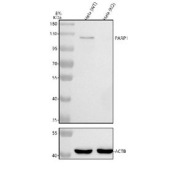
Antibodies included in this collection have been evaluated using gene silencing methods such as shRNA knockdown. In a typical validation experiment, lysates from wild-type cells are compared to lysates from cells in which the target gene has been reduced or silenced. A decrease in the detected band at the expected molecular weight supports target-specific binding.
In many cases, a loading control protein is included to confirm equal protein input across samples, ensuring that observed differences reflect true changes in target expression rather than variation in sample loading.
This collection includes antibodies against proteins involved in cytoskeletal structure, signaling pathways, transcriptional regulation, and cell cycle control. Many of these targets are widely studied in cancer biology, neuroscience, and developmental biology, where accurate detection of protein expression is essential.
Notable examples include cytoskeletal proteins such as tubulin isoforms, which are frequently validated using knockdown approaches due to their high abundance and importance in cellular structure and function.
By incorporating knockdown validation data, these antibodies provide an additional level of confidence for researchers seeking reliable and reproducible results. This validation strategy helps ensure that observed signals correspond to the intended protein target, supporting accurate data interpretation across a wide range of experimental designs.
Researchers seeking orthogonal specificity validation strategies may also be interested in our Human Protein Microarray Validated Antibodies landing page featuring antibodies screened against thousands of full-length human proteins to evaluate target selectivity and off-target binding profiles.
A selection of knockdown validated antibody products is shown below to support a range of research applications.
These knockdown validated antibodies are part of a broader antibody panel offered by NSJ Bioreagents.

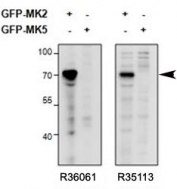
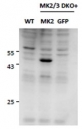
Knockdown Validated Antibody Western Blot. Western blot analysis of protein expression in wild-type and shRNA knockdown HeLa cells demonstrating reduced target signal following gene silencing. A band is detected at the expected molecular weight in control samples and is reduced in knockdown samples, confirming target-specific antibody binding. Loading control is included to verify equal protein input.


 Powered by Bioz





 info@nsjbio.com