- Tel: 858.663.9055
 Email: info@nsjbio.com
- Tel: 858.663.9055
- Email: info@nsjbio.com
Email: info@nsjbio.com
Human Protein Microarray Validated Antibody reagents represent a high standard of antibody validation, offering researchers exceptional confidence in specificity and reproducibility. Antibody validation is a critical factor in modern science, as cross-reactivity or non-specific binding can undermine experimental outcomes. Human protein microarrays contain thousands of unique proteins expressed from the human genome, enabling comprehensive testing of antibody interactions.
When an antibody passes microarray validation, it has been screened against a vast panel of human proteins to evaluate binding to its intended target and identify potential off-target interactions. This rigorous process provides broad specificity data that can reduce the risk of false positives and strengthen confidence in antibody performance. This rigorous process reduces false positives and enhances reproducibility across assays. The Human Protein Microarray Validated Antibody ensures that signals in immunoassays arise from specific antigen recognition rather than background cross-reactivity.
By selecting Human Protein Microarray Validated Antibodies, researchers can trust that their reagents have been vetted under one of the most stringent validation methods available in biomedical science.
NSJ Bioreagents offers Human Protein Microarray Validated Antibodies that have undergone extensive quality assurance. Each antibody is screened on human protein arrays, ensuring specificity and reducing the likelihood of off-target interactions.
By choosing a Human Protein Microarray Validated Antibody from NSJ Bioreagents, scientists gain reagents optimized for reproducibility, making them suitable for both discovery research and translational studies. HuProt validation provides an additional layer of specificity assessment that complements application-specific validation such as immunohistochemistry, western blotting, flow cytometry, ELISA, and immunofluorescence. Detailed datasheets, usage recommendations, and experimental controls further support the reliability of these reagents.
HuProt human protein microarrays have been used in peer-reviewed antibody validation studies to assess monoclonal antibody specificity across a broad representation of the human proteome. In a study published in Nature Methods, Venkataraman et al. used HuProt microarrays as a primary validation tool to identify monoclonal antibodies with high specificity for their intended targets. Antibodies passing the HuProt specificity screen were subsequently evaluated using additional application-specific methods, demonstrating how proteome-wide screening can complement conventional antibody validation techniques.
Reference: Venkataraman A, Yang K, Irizarry J, et al. A toolbox of immunoprecipitation-grade monoclonal antibodies to human transcription factors. Nature Methods. 2018;15:330-338. doi: 10.1038/nmeth.4632.
The Human Protein Microarray Validated Antibody is versatile and applicable across many fields of biomedical science.
Human Protein Microarray Validated Antibodies used in IHC / IF provides additional confidence/support that staining reflects true antigen localization.
The Human Protein Microarray Validated Antibody reduces the risk of cross-reactive signals in tissue sections.
Human Protein Microarray Validated Antibodies for WB provide clarity in protein bands.
Proteome-wide specificity screening can help identify potential off-target interactions before antibodies are evaluated by western blot.
Human Protein Microarray Validated Antibodies provide confidence in multiparametric immune profiling.
The Human Protein Microarray Validated Antibody provides additional confidence/support for accurate gating and subset analysis.
Human protein microarray screening provides additional target-specificity data for antibodies used in quantitative assays.
The Human Protein Microarray Validated Antibody supports biomarker discovery and validation.
Human Protein Microarray Validated Antibodies confirm specificity of biomarkers under clinical investigation.
The Human Protein Microarray Validated Antibody is suitable for preclinical therapeutic validation.
Human Protein Microarray Validated Antibodies provide reference controls for drug development.
Human protein microarray screening can help identify potential protein cross-reactivity during antibody development and characterization.
Specificity is the cornerstone of antibody-based research. Human protein microarray validation provides broad specificity data that can increase confidence that observed antibody binding reflects recognition of the intended antigen. Meanwhile, Human Protein Microarray Validated Antibodies more broadly represent a category of reagents that elevate research standards by minimizing false positives and irreproducible results.
In basic biology, these antibodies ensure accurate mapping of protein localization and signaling. In disease-focused studies, Human Protein Microarray Validated Antibodies highlight dysregulated proteins with confidence. In translational medicine, they support biomarker validation and therapeutic development with reduced risk of cross-reactivity.
Clinically, validation of antibody specificity is critical for diagnostic assay development and therapeutic antibody safety. By providing rigorously tested reagents, the Human Protein Microarray Validated Antibody bridges discovery science with clinical application.
Human protein microarray screening provides a powerful approach for evaluating antibody specificity across thousands of human proteins. By assessing intended target recognition alongside potential off-target interactions, HuProt validation provides complementary specificity data that strengthens conventional application-specific antibody validation. By minimizing cross-reactivity and enhancing reproducibility, these antibodies remain indispensable for advancing biomedical discovery and clinical science.
These antibodies are part of a broader antibody panel offered by NSJ Bioreagents.

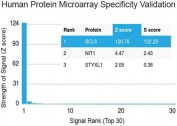
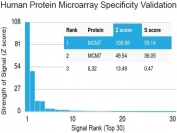
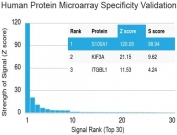
Analysis of HuProt(TM) microarray containing more than 19,000 full-length human proteins using Ki67 Antibody (clone MKI67/2462). The strong preferential signal for Ki67 relative to other proteins represented on the array demonstrates the target specificity of the MKI67/2462 monoclonal antibody.



 Powered by Bioz





 info@nsjbio.com