- Tel: 858.663.9055
 Email: info@nsjbio.com
- Tel: 858.663.9055
- Email: info@nsjbio.com
Email: info@nsjbio.com
Minichromosome maintenance complex component 7 (MCM7) is a DNA replication licensing factor that plays a central role in the initiation of DNA synthesis and progression through the cell cycle. As a core component of the MCM2-7 helicase complex, MCM7 is required for DNA unwinding at replication origins and is tightly regulated during the G1 and S phases. Because its expression is restricted to actively cycling cells, MCM7 is widely used as a marker of cellular proliferation and replication competence.
Antibodies targeting MCM7 are commonly used to identify proliferating cells in both normal and tumor tissues, as well as to study replication dynamics in biochemical assays such as western blot and immunofluorescence.
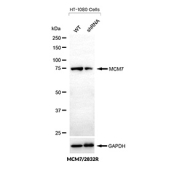
For applications requiring high specificity, a subset of MCM7 antibodies has been evaluated using gene silencing approaches. These knockdown validated antibodies demonstrate reduced signal in shRNA-treated cells compared to wild-type controls, supporting target-specific detection.
A representative MCM7 knockdown validated antibody provides functional confirmation of specificity in western blot analysis, making it a strong choice for studies involving gene regulation, protein expression changes, and pathway analysis.
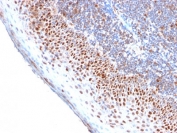
MCM7 is strongly expressed in proliferating cells within tissue sections, making it particularly useful for immunohistochemistry-based analysis of cellular proliferation. In lymphoid tissues such as tonsil and lymph node, MCM7 staining highlights germinal center cells and other proliferative compartments.
Explore MCM7 antibody for IHC and MCM7 tissue microarray antibody options for detecting nuclear expression patterns across normal and cancer tissues. These antibodies are well suited for studies of tumor proliferation, tissue architecture, and cell cycle activity.
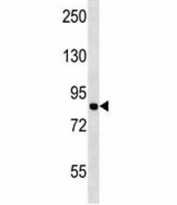
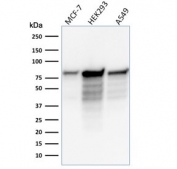
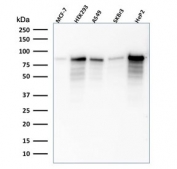
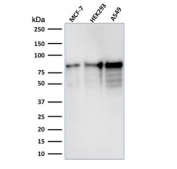
Western blot analysis of MCM7 typically reveals a band at approximately 75–80 kDa, consistent with its predicted molecular weight. Detection of MCM7 in cell lysates provides a reliable method for assessing proliferation-associated protein expression.
Browse MCM7 antibody for western blot options designed for clear band detection and reproducible results across cell line and tissue samples.
In immunofluorescence applications, MCM7 antibodies enable visualization of nuclear localization in proliferating cells. This approach is useful for studying cell cycle dynamics, subcellular localization, and spatial distribution of replication-associated proteins.
View MCM7 antibody for immunofluorescence to support imaging-based studies of cell proliferation and nuclear protein distribution.
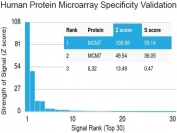
Additional validation approaches, including protein microarray and HuProt screening, provide further confirmation of antibody specificity. These methods assess binding across thousands of proteins to ensure selective target recognition.
Explore MCM7 microarray validated antibody and MCM7 HuProt validated antibody options for applications requiring high specificity and minimal off-target binding.
MCM7 antibodies provide a versatile toolset for studying DNA replication, cell cycle progression, and tumor biology. By combining application-specific formats such as IHC, western blot, immunofluorescence, and knockdown validation, this antibody panel supports a wide range of experimental approaches focused on proliferative activity.
A selection of MCM7 antibody products is shown below to support a range of research applications.
Researchers studying DNA replication licensing, cellular proliferation pathways, and oncogenic cell cycle regulation may also be interested in our Cancer Antibodies landing page featuring tumor biomarkers, nuclear proteins, and oncology related targets.
These antibodies are part of a broader antibody panel offered by NSJ Bioreagents.
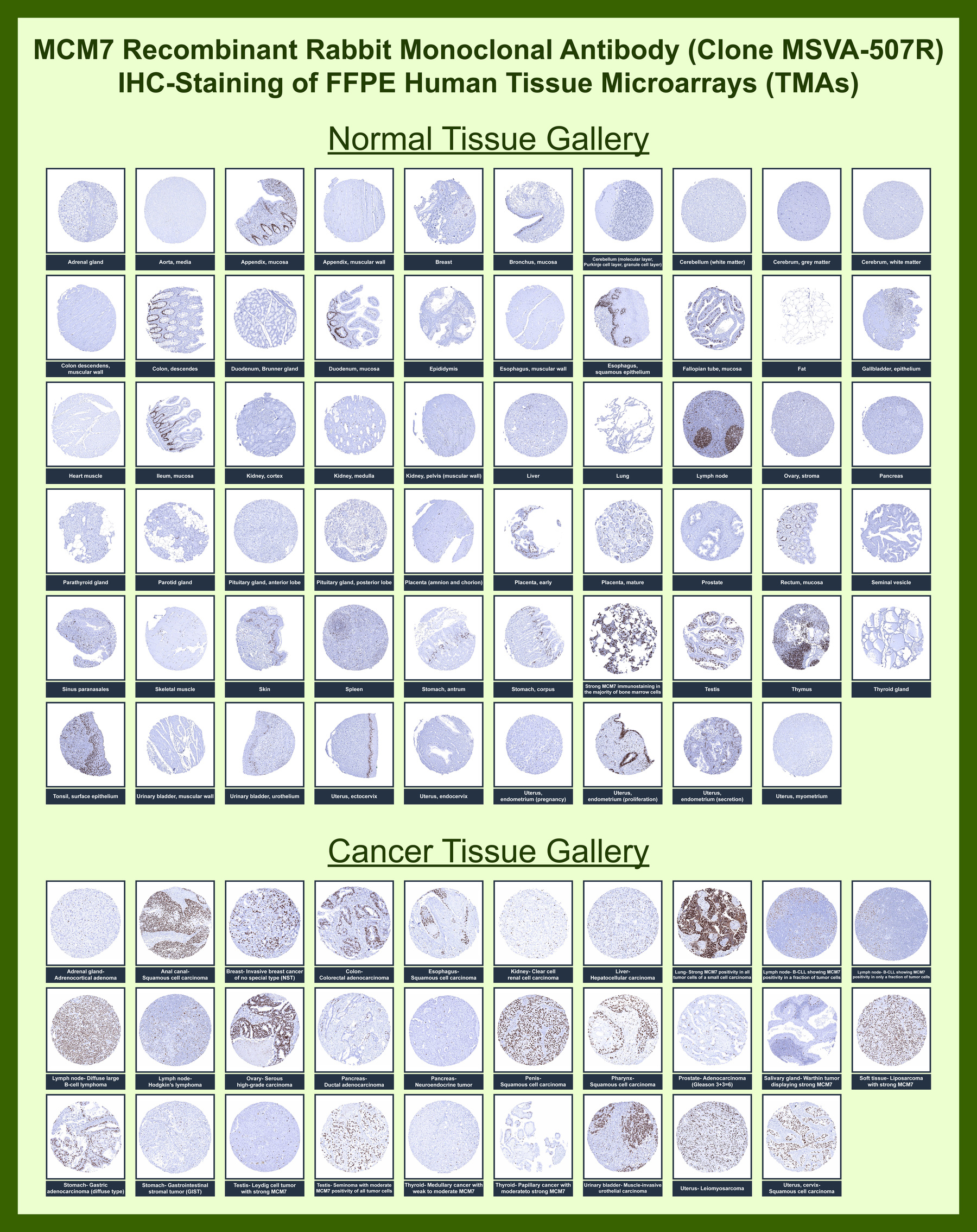
MCM7 Antibody IHC Tissue Microarray (TMA). Immunohistochemistry analysis of Minichromosome maintenance protein 7 (MCM7) across human tissue microarray (TMA) panels using MCM7 antibody. Nuclear staining highlights proliferating cells in multiple normal and cancer tissues, with strong signal in germinal centers and tumor regions consistent with active DNA replication and cell cycle progression.


 Powered by Bioz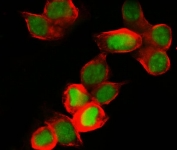





 info@nsjbio.com