- Tel: 858.663.9055
 Email: info@nsjbio.com
- Tel: 858.663.9055
- Email: info@nsjbio.com
Email: info@nsjbio.com
IgG antibody detection is essential for studying systemic immune responses and antibody-mediated immunity. Immunoglobulin G (IgG) is the most abundant antibody class in circulation and plays a central role in long-term immunity, immune memory, and pathogen neutralization. Accurate detection of IgG is critical for evaluating immune status, antibody production, and response to infection or vaccination.
IgG Antibody for ELISA applications enables sensitive and reliable quantification of immunoglobulin G in serum, plasma, and other biological samples. These antibodies are widely used in immunology research, serological testing, and antibody development workflows where precise measurement of IgG is required.
IgG is composed of two heavy chains and two light chains forming a Y-shaped structure that enables antigen binding and immune effector functions. The Fc region of IgG mediates interactions with immune cells and complement proteins, supporting processes such as antibody-dependent cellular cytotoxicity and opsonization.
IgG is the dominant antibody in serum and is responsible for long-term immune protection following infection or vaccination. Its relatively long half-life and stability make it a key marker for assessing sustained immune responses.
IgG Antibody for ELISA systems are optimized for sensitive and specific detection of immunoglobulin G in complex biological samples. These assays support:
Because IgG is the primary circulating immunoglobulin, its detection provides critical insight into immune status and long-term antibody production.
IgG is divided into four subclasses - IgG1, IgG2, IgG3, and IgG4 - which differ in structure, abundance, and immune function.
Subclass-specific antibodies allow more detailed analysis of immune responses, particularly in studies of infection, vaccination, and immune regulation.
IgG antibodies are widely used in:
Because IgG reflects long-term immune memory, its detection is a key component of immune monitoring and disease research.
IgG antibodies are essential tools for studying systemic immunity and long-term antibody responses. From total IgG quantification to subclass-specific analysis, these antibodies support a wide range of ELISA-based applications in immunology, serology, and biomedical research.
Explore our immunoglobulin antibody collection to find IgG, IgA, and IgM antibodies optimized for ELISA-based detection and immunological analysis.
Researchers studying adaptive humoral immunity, immunoglobulin detection systems, and ELISA based antibody quantification assays may also be interested in our Immunology Antibodies landing page featuring cytokines, immune markers, and host defense related proteins.
Browse the complete collection of research antibodies on our Antibodies landing page.
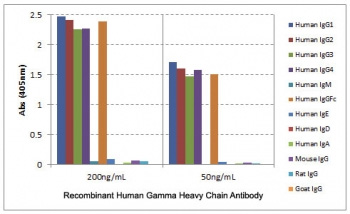
Human IgG Antibody for ELISA Subclass Specificity Analysis. ELISA analysis of human immunoglobulins demonstrates that clone RM116 selectively recognizes Human IgG / IGHG, with strong signal observed for IgG1, IgG2, IgG3, and IgG4 heavy chains as well as the Fc region of IgG across tested concentrations.




 Powered by Bioz





 info@nsjbio.com