- Tel: 858.663.9055
 Email: info@nsjbio.com
- Tel: 858.663.9055
- Email: info@nsjbio.com
Email: info@nsjbio.com
IgG1 antibody detection is essential for studying antibody-mediated immune responses and subclass-specific immunoglobulin dynamics. Immunoglobulin G1 (IgG1) is the most abundant IgG subclass in circulation and plays a dominant role in systemic immunity. Accurate detection of IgG1 is critical for evaluating antibody responses, immune status, and antigen-specific immunity in a wide range of research applications.
IgG1 Antibody for ELISA applications enables selective quantification of immunoglobulin G1 in serum, plasma, and other biological samples. These antibodies are widely used in immunology research, vaccine studies, and antibody response profiling where subclass-specific detection is required.
IgG1 is structurally characterized by a flexible hinge region and strong interaction with Fc receptors and complement proteins. These features support efficient immune effector functions, including antibody-dependent cellular cytotoxicity and complement activation.
Functionally, IgG1 is the primary subclass generated in response to protein antigens and is a major contributor to adaptive immune responses. It is commonly associated with robust antibody production following infection or vaccination and serves as a key indicator of immune activation and long-term immunity.
IgG1 Antibody for ELISA systems are optimized for sensitive and selective detection of immunoglobulin G1 in complex biological samples. These assays support:
Because IgG1 is the dominant IgG subclass, its detection provides critical insight into antibody production and immune response dynamics.
IgG is divided into four subclasses - IgG1, IgG2, IgG3, and IgG4 - each with distinct roles in immune responses.
Subclass-specific antibodies enable detailed characterization of immune responses and improve the resolution of ELISA-based immunoassays.
IgG1 antibodies are widely used in:
Because IgG1 is a key indicator of adaptive immune responses, its detection provides valuable insight into immune function and antibody-mediated immunity.
IgG1 antibodies provide essential tools for studying antibody responses and subclass-specific immune dynamics. Their ability to selectively detect immunoglobulin G1 enables precise analysis of immune activity, antibody production, and antigen-specific responses.
Explore our immunoglobulin antibody collection to find IgG, IgG1, IgG2, IgG3, and IgG4 antibodies optimized for ELISA-based detection and subclass-specific analysis.
Researchers studying immunoglobulin subclass biology, Fc mediated immune responses, and ELISA based antibody quantification assays may also be interested in our Immunology Antibodies landing page featuring cytokines, immune markers, and host defense related proteins.
Browse the complete collection of research antibodies on our Antibodies landing page.
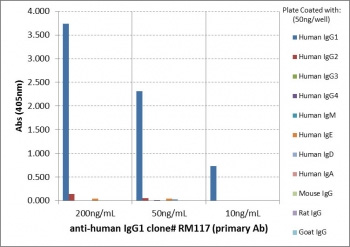
Human IgG1 Antibody for ELISA Subclass Specificity Analysis. ELISA analysis of human immunoglobulin subclasses demonstrates that clone RM117 selectively recognizes Human IgG1 / IGHG1, with strong signal observed for IgG1 across tested concentrations, while no cross-reactivity is detected with IgG2, IgG3, IgG4, IgE, IgD, or IgA, or with non-human IgG from mouse, rat, or goat.




 Powered by Bioz



 info@nsjbio.com