- Tel: 858.663.9055
 Email: info@nsjbio.com
- Tel: 858.663.9055
- Email: info@nsjbio.com
Email: info@nsjbio.com
IgG3 antibody detection is critical for studying highly active antibody responses and early-stage immune activation. Immunoglobulin G3 (IgG3) is a functionally potent IgG subclass known for its strong ability to activate complement and engage immune effector mechanisms. Accurate detection of IgG3 enables detailed analysis of immune responses in infection, inflammation, and antibody-mediated immunity.
IgG3 Antibody for ELISA applications enables selective quantification of immunoglobulin G3 in serum, plasma, and other biological samples. These antibodies are widely used in immunology research, infectious disease studies, and immune response profiling where subclass-specific detection is required.
IgG3 is structurally distinguished by an extended hinge region that provides increased flexibility and accessibility for antigen binding. This structural feature contributes to its enhanced ability to activate complement and interact with Fc receptors compared to other IgG subclasses.
Functionally, IgG3 is one of the most effective mediators of antibody-dependent immune responses. It plays a key role in pathogen clearance through complement activation, opsonization, and engagement of immune effector cells. IgG3 is often associated with early immune responses to infection and strong antibody-mediated immunity.
IgG3 Antibody for ELISA systems are optimized for sensitive and selective detection of immunoglobulin G3 in complex biological samples. These assays support:
Because IgG3 has strong effector function but is typically present at lower levels than IgG1, its detection provides important insight into immune response dynamics that may not be captured by total IgG measurement alone.
IgG is divided into four subclasses - IgG1, IgG2, IgG3, and IgG4 - each with distinct biological roles.
Subclass-specific antibodies enable more precise analysis of immune responses and improve the resolution of ELISA-based immunoassays.
IgG3 antibodies are widely used in:
Because IgG3 is strongly associated with potent immune activation, its detection provides valuable insight into early immune responses and high-effector antibody activity.
IgG3 antibodies provide essential tools for studying high-effector immune responses and subclass-specific immunoglobulin dynamics. Their ability to selectively detect immunoglobulin G3 enables precise analysis of complement activation, pathogen clearance, and immune system function.
Explore our immunoglobulin antibody collection to find IgG, IgG1, IgG2, IgG3, and IgG4 antibodies optimized for ELISA-based detection and subclass-specific analysis.
Researchers studying Fc mediated immune effector functions, immunoglobulin subclass signaling, and ELISA based antibody detection assays may also be interested in our Immunology Antibodies landing page featuring cytokines, immune markers, and host defense related proteins.
Browse the complete collection of research antibodies on our Antibodies landing page.
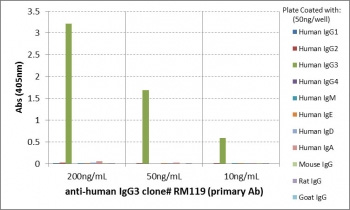
Human IgG3 Antibody for ELISA Subclass Specificity Analysis. ELISA analysis of human immunoglobulins demonstrates that clone RM119 selectively recognizes Human IgG3, with strong signal observed across tested concentrations. No cross-reactivity is detected with IgG1, IgG2, or IgG4, or with other immunoglobulin classes including IgM, IgA, IgD, and IgE, or with mouse, rat, or goat IgG.




 Powered by Bioz


 info@nsjbio.com