- Tel: 858.663.9055
 Email: info@nsjbio.com
- Tel: 858.663.9055
- Email: info@nsjbio.com
Email: info@nsjbio.com
IgG4 antibody detection is important for studying immune regulation and antibody responses associated with chronic antigen exposure. Immunoglobulin G4 (IgG4) is a unique IgG subclass characterized by reduced effector function and involvement in immune tolerance mechanisms. Accurate detection of IgG4 enables detailed analysis of regulatory immune responses and subclass-specific immunoglobulin dynamics.
IgG4 Antibody for ELISA applications enables selective quantification of immunoglobulin G4 in serum, plasma, and other biological samples. These antibodies are widely used in immunology research, allergy studies, and investigations of chronic immune stimulation where subclass-specific detection is required.
IgG4 is structurally distinct from other IgG subclasses due to its ability to undergo Fab-arm exchange, resulting in functionally monovalent antibodies with reduced capacity to crosslink antigens. This structural property contributes to its limited ability to activate complement and engage immune effector mechanisms.
Functionally, IgG4 is associated with immune regulation and tolerance rather than inflammation. It is often elevated in response to prolonged antigen exposure, such as in chronic infections, allergen desensitization, and certain immune-mediated conditions. IgG4 plays a role in dampening immune responses and limiting excessive inflammation.
IgG4 Antibody for ELISA systems are optimized for sensitive and selective detection of immunoglobulin G4 in complex biological samples. These assays support:
Because IgG4 is typically present at lower levels and reflects regulatory immune processes, its detection provides important insight into immune balance and chronic antigen exposure.
IgG is divided into four subclasses - IgG1, IgG2, IgG3, and IgG4 - each contributing differently to immune responses.
Subclass-specific antibodies enable detailed characterization of immune responses and improve the resolution of ELISA-based immunoassays.
IgG4 antibodies are widely used in:
Because IgG4 is linked to regulatory immune responses, its detection provides valuable insight into immune modulation and long-term antigen exposure.
IgG4 antibodies provide essential tools for studying immune regulation and subclass-specific immunoglobulin dynamics. Their ability to selectively detect immunoglobulin G4 enables precise analysis of tolerance mechanisms, chronic immune responses, and antibody-mediated regulation.
Explore our immunoglobulin antibody collection to find IgG, IgG1, IgG2, IgG3, and IgG4 antibodies optimized for ELISA-based detection and subclass-specific analysis.
Researchers studying immunoglobulin subclass regulation, Fc mediated immune interactions, and ELISA based antibody detection assays may also be interested in our Immunology Antibodies landing page featuring cytokines, immune markers, and host defense related proteins.
Browse the complete collection of research antibodies on our Antibodies landing page.
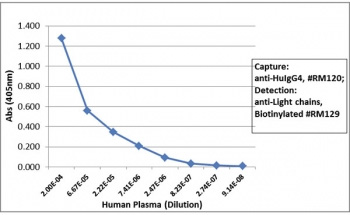
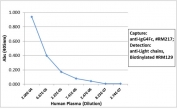
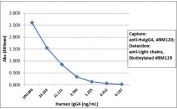
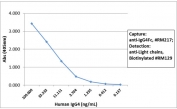
Human IgG4 Antibody for ELISA Sandwich ELISA Human Plasma. Sandwich ELISA analysis of human plasma demonstrates that clone RM120 functions effectively as a capture antibody for Human IgG4 / IGHG4, with signal intensity decreasing proportionally with sample dilution, indicating robust and concentration-dependent detection.


 Powered by Bioz





 info@nsjbio.com