- Tel: 858.663.9055
 Email: info@nsjbio.com
- Tel: 858.663.9055
- Email: info@nsjbio.com
Email: info@nsjbio.com
CD5 is a cell surface glycoprotein expressed primarily on T lymphocytes and a subset of B cells, making it a widely used marker for immune cell identification and lymphoid disease classification. CD5 antibodies are essential tools for detecting T cell populations, evaluating immune infiltration, and distinguishing between different types of lymphoid malignancies in both research and diagnostic settings. Because CD5 is consistently expressed on mature T cells and selectively present on certain B cell subsets, it plays a central role in immunophenotyping workflows across multiple assay formats.
CD5 functions as a negative regulator of antigen receptor signaling, modulating T cell receptor activation and contributing to immune tolerance. It is highly expressed in thymocytes and peripheral T cells, with additional expression in CD5-positive B cell populations such as those found in mantle zones and chronic lymphocytic leukemia (CLL). This restricted and well-characterized expression pattern makes CD5 antibody a reliable marker for identifying T cell lineage and for distinguishing CD5-positive B cell neoplasms from other hematologic malignancies.
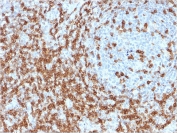
CD5 antibodies for IHC are widely used to visualize T cell distribution within formalin-fixed, paraffin-embedded (FFPE) tissues. Immunohistochemistry enables clear membranous staining of T lymphocytes within lymphoid organs such as tonsil, lymph node, and thymus, as well as within tumor microenvironments. CD5 immunohistochemistry antibody staining is routinely included in diagnostic panels for lymphoma classification, where it helps distinguish T cell lymphomas from B cell malignancies and identify CD5-positive B cell disorders including mantle cell lymphoma and CLL. Tissue microarray (TMA) analysis further enhances the utility of CD5 IHC antibodies by enabling comparative staining across large panels of normal and cancer tissues in a single experiment.
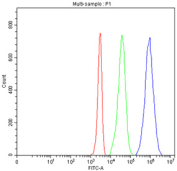
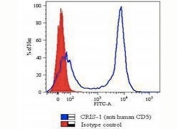
CD5 antibodies for flow cytometry are used to analyze immune cell populations at the single-cell level, providing quantitative assessment of CD5 expression across T cell subsets and CD5-positive B cells. In flow cytometry applications, CD5 serves as a key marker in immunophenotyping panels for leukemia and lymphoma, allowing precise classification of hematologic malignancies. Fluorophore-conjugated CD5 antibodies enable multiparametric analysis alongside markers such as CD3, CD19, and CD20, supporting detailed characterization of immune cell populations.
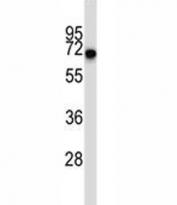
CD5 antibodies for western blot are used to detect CD5 protein expression in cell and tissue lysates. Western blot analysis confirms protein size and expression levels, complementing tissue-based and cell-based assays. CD5 antibody for WB is particularly useful for validating expression in immune cell lines and studying signaling pathways involving CD5-mediated regulation of T cell activation.
CD5 antibodies for immunofluorescence enable visualization of CD5 localization at the cellular level using fluorescence microscopy. In IF applications, CD5 antibody staining highlights membrane localization in T lymphocytes and can be combined with additional markers to study immune cell interactions and spatial organization. This approach is valuable for investigating immune synapse formation and cellular communication within tissues.
CD5 antibodies are critical reagents for studying immune biology, lymphoid tissue organization, and hematologic malignancies. Their versatility across immunohistochemistry, flow cytometry, western blot, and immunofluorescence makes them indispensable tools for both basic research and clinical investigation and a crutial part of our CD Antibody collection.
Researchers exploring adaptive immune responses, leukocyte activation networks, and immune signaling mechanisms may also be interested in our Immunology Antibodies landing page featuring cytokines, immune receptors, and inflammatory response related proteins.
Browse the complete collection of research antibodies on our Antibodies landing page.
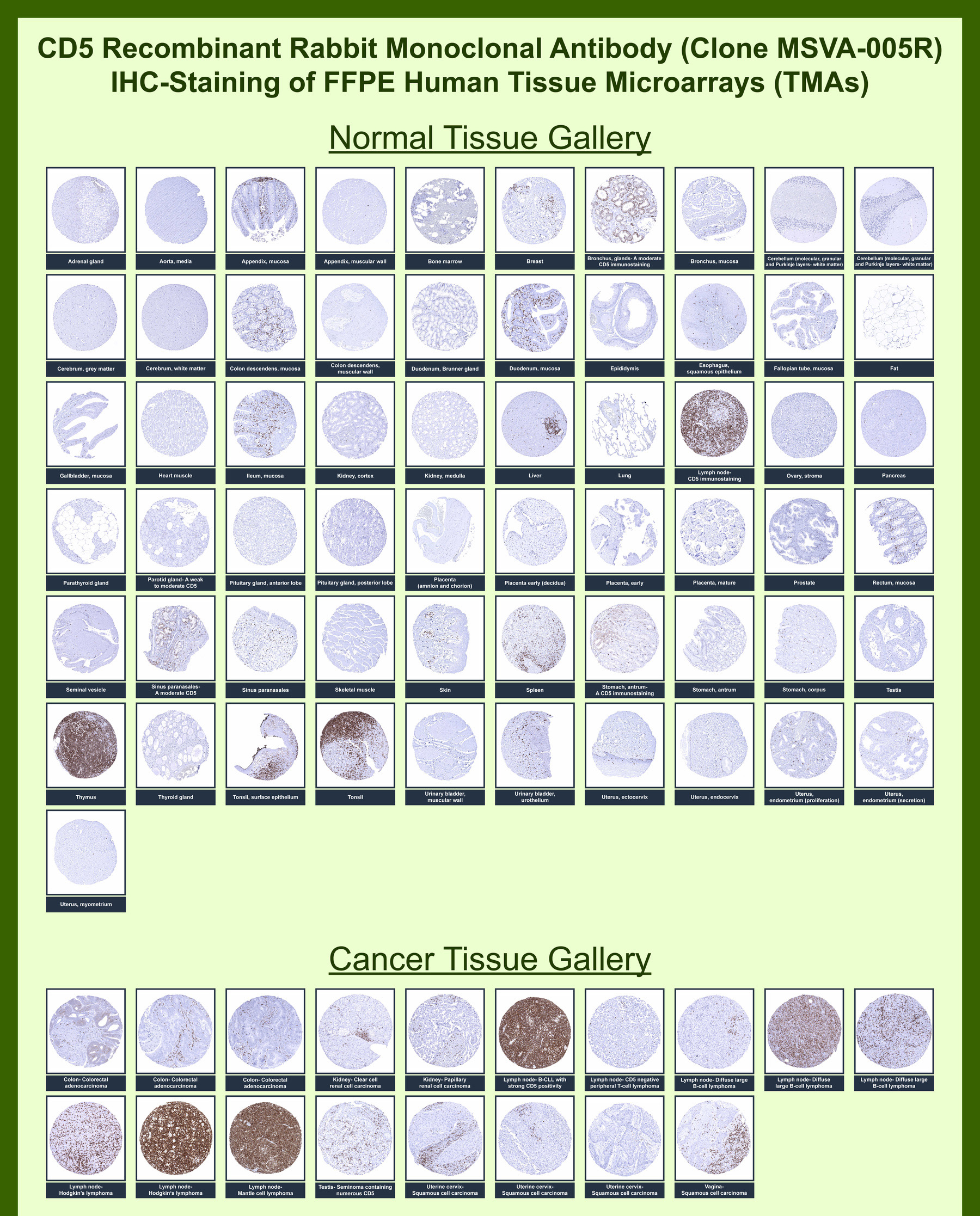
CD5 Antibody for IHC. Immunohistochemistry analysis of CD5 antibody staining in human tissue microarray (TMA) sections using clone MSVA-005R, Cat # V6141, a recombinant rabbit monoclonal antibody. Strong membranous staining is observed in T cell-rich tissues including tonsil, lymph node, and thymus, with dense labeling of lymphoid zones consistent with CD5 expression on mature T lymphocytes. Within cancer tissue microarrays, prominent staining is seen in lymphoid malignancies such as Hodgkin lymphoma, mantle cell lymphoma, and CD5-positive B cell neoplasms, while most non-hematologic tumors remain negative except for infiltrating immune cells. Across the TMA panel containing a wide range of normal and cancer tissues, staining patterns align with established CD5 biology and publicly available datasets including Human Protein Atlas, supporting the use of this antibody for high-throughput immunohistochemistry and comparative tissue profiling.




 Powered by Bioz




 Citations (5)


 info@nsjbio.com