- Tel: 858.663.9055
 Email: info@nsjbio.com
- Tel: 858.663.9055
- Email: info@nsjbio.com
Email: info@nsjbio.com
Tumor protein p53 (TP53), commonly referred to as p53, is a critical tumor suppressor that regulates cell cycle progression, DNA repair, and apoptosis in response to cellular stress. The p53 antibody is widely used in research to study protein expression, mutation-associated accumulation, and signaling pathways involved in cancer development. As one of the most frequently altered genes in human tumors, p53 plays a central role in maintaining genomic stability and preventing uncontrolled cell growth.
p53 antibody, also known as TP53 antibody or tumor suppressor protein antibody, enables detection of nuclear protein expression across a wide range of tissues and experimental models. p53 functions primarily as a transcription factor localized in the nucleus, where it regulates genes involved in cell cycle arrest, apoptosis, and DNA damage response. In many cancers, mutant p53 proteins exhibit increased stability, leading to nuclear accumulation that can be detected in tumor cells and compared with proliferation-associated markers such as Ki67 proliferation marker antibody.
p53 is a central regulator of the cellular response to DNA damage. Upon activation, p53 induces transcription of genes that halt cell cycle progression and initiate repair mechanisms or apoptosis. p53 antibody enables investigation of these pathways by allowing detection of protein expression changes following radiation, oxidative stress, and genotoxic treatments.
Mutations in TP53 are among the most common genetic alterations in human cancers. These mutations often result in loss of tumor suppressor function or gain of oncogenic activity. p53 antibody is widely used to study tumor-associated expression patterns, including nuclear accumulation of mutant protein and altered signaling pathways in cancer cells. In epithelial malignancies, p53 staining patterns are often interpreted alongside cytokeratin epithelial marker antibodies to help characterize tumor cell populations and tissue context.
p53 plays a critical role in controlling the G1-S checkpoint of the cell cycle by regulating expression of downstream targets such as p21. Through these mechanisms, p53 ensures that damaged DNA is not propagated during cell division. This growth-suppressive role contrasts with proteins associated with active proliferation, making p53 and Ki67 complementary markers for evaluating tumor growth dynamics.
p53 belongs to a broader transcription factor family that includes p63 and p73, which share structural similarity but differ in tissue distribution and biological role. While p53 is most closely linked to DNA damage surveillance and tumor suppression, p63 transcription factor antibody is especially relevant to epithelial development, basal cell biology, and squamous differentiation. This relationship makes p53 and p63 useful complementary markers in research focused on cancer classification and lineage-associated signaling.
In response to severe cellular stress, p53 promotes apoptosis through transcription-dependent and independent mechanisms. p53 is also involved in senescence, metabolic regulation, and oxidative stress response, extending its importance beyond tumor suppression alone. p53 antibody therefore provides a powerful tool for analyzing nuclear protein expression, stress signaling, and cell fate control across diverse biological systems.
Researchers studying tumor suppressor signaling, DNA damage response pathways, and cell cycle regulatory mechanisms may also be interested in our Cancer Antibodies landing page featuring tumor biomarkers, signaling mediators, and oncology related targets.
For additional antibody categories and targets, explore our antibody overview page.
Please find a sampling of the p53 antibodies available from NSJ Bioreagents below.
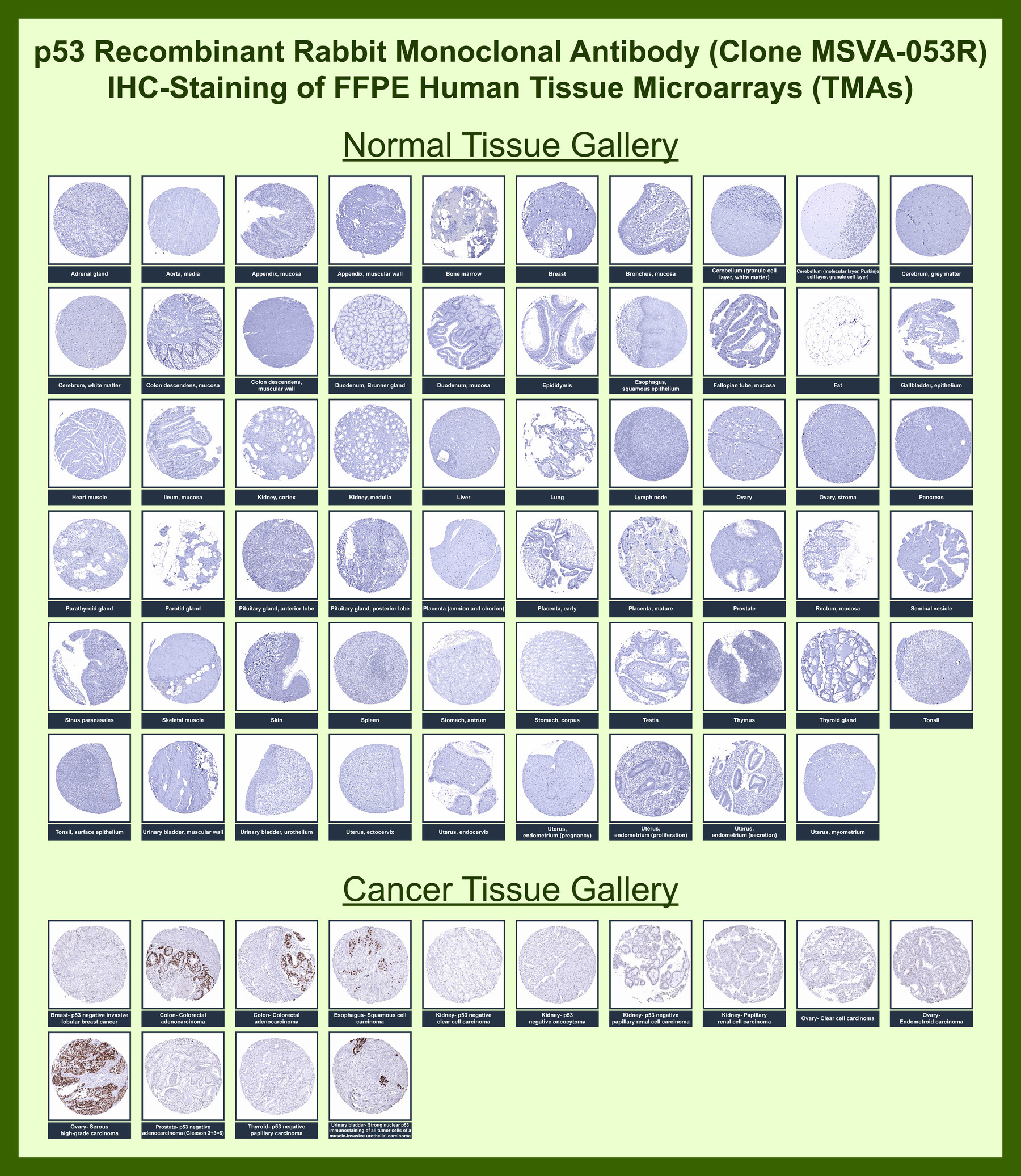
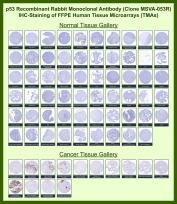
p53 Antibody for IHC. Immunohistochemistry analysis of p53 / TP53 expression in human tissue microarray (TMA) using p53 antibody clone MSVA-053R. FFPE human tissue microarrays containing multiple normal and cancer tissues were stained, showing predominantly nuclear HRP-DAB brown signal in subsets of tumor cells, consistent with accumulation of Tumor protein p53 in neoplastic tissues, while most normal tissues display weak or minimal nuclear staining. Strong nuclear signal is observed in colorectal, breast, ovarian, and additional carcinoma samples, whereas non-neoplastic tissues exhibit low basal expression. The staining distribution reflects established TP53 expression patterns and supports the use of p53 antibody for cancer biomarker analysis and tumor biology research.


 Powered by Bioz


 Citations (12)






 info@nsjbio.com