- Tel: 858.663.9055
 Email: info@nsjbio.com
- Tel: 858.663.9055
- Email: info@nsjbio.com
Email: info@nsjbio.com
Antibodies are essential tools for protein detection and analysis across a wide range of biological systems, and primary antibodies are widely used in research to identify specific targets in tissues, cells, and biochemical assays. Primary antibodies are used in research to identify specific proteins in tissues, cells, and biochemical assays, supporting studies in immunology, cancer biology, neuroscience, and metabolism. Antibody reagents enable precise detection of targets including cell surface markers, structural proteins, enzymes, and membrane transport proteins.
This antibody collection provides access to a broad range of target-specific antibody categories organized by biological function and protein family. These include immune cell marker antibodies, epithelial and cytoskeletal markers, membrane transport proteins, and intracellular signaling targets. Each category contains multiple antibody products designed to support protein detection, localization, and functional analysis.
Browse the full alphabetical antibody listing here.
Immune cell marker antibodies are widely used to identify and characterize specific immune cell populations in research applications. These antibodies target cell surface proteins involved in immune signaling, activation, and differentiation, supporting studies in immunology, oncology, and inflammatory disease. CD marker antibodies are among the most commonly used tools for profiling T cells, B cells, and other immune populations based on antigen expression patterns.
Epithelial and cytoskeletal marker antibodies are essential for studying tissue structure, cellular differentiation, and epithelial lineage. These antibodies target proteins such as cytokeratins that define epithelial identity and are widely used in cancer research and pathology. Cytokeratin antibodies enable identification of epithelial-derived cells and support classification of tumor origin based on structural protein expression.
Membrane transport and channel protein antibodies are used to study the movement of water, ions, and small molecules across biological membranes. These proteins play critical roles in cellular homeostasis, fluid regulation, and metabolic processes. Aquaporin antibodies are widely used to investigate water channel proteins involved in kidney function, brain water balance, and epithelial transport systems.
Tumor and disease marker antibodies are widely used to study cancer biology, cellular differentiation, and disease-associated protein expression. These antibodies enable detection of proteins involved in tumor progression, angiogenesis, and epithelial lineage. Common targets include endothelial markers such as CD34 and differentiation markers such as p63, which are frequently used in oncology and pathology research.
• CD34 endothelial marker antibody - commonly used to identify endothelial cells and study tumor angiogenesis, vascular structure, and microvessel density in cancer tissues.
• p63 tumor marker antibody - a key marker of squamous cell differentiation widely used in studies of epithelial tumors and cancer classification.
Intracellular and signaling protein antibodies are essential for studying nuclear function, transcriptional regulation, and cell cycle control. These antibodies target proteins such as p53, Ki67, and Major Vault Protein (MVP), which are involved in proliferation, stress response, and intracellular transport pathways across a wide range of biological systems.
• p53 tumor suppressor antibody - widely used to investigate DNA damage response, cell cycle control, and cancer-associated mutations across multiple tumor types.
• Ki67 proliferation marker antibody - a well-established tool for assessing cell division and growth activity in normal and cancer tissues.
• MVP intracellular transport protein antibody - targets Major Vault Protein, supporting studies of cellular transport mechanisms, signaling pathways, and multidrug resistance.
Antibody products are used across a variety of research applications, including protein detection, tissue localization, and expression analysis. These tools support experimental approaches for studying protein function, cellular structure, and disease mechanisms across multiple biological contexts.
Explore antibodies by application including IHC, western blot, IF and flow cytometry.
Explore antibodies by application, including IHC, western blot, immunofluorescence, and flow cytometry.
This antibody overview page is part of a broader antibody panel offered by NSJ Bioreagents.
A selection of antibody products is shown below to support a range of research applications.
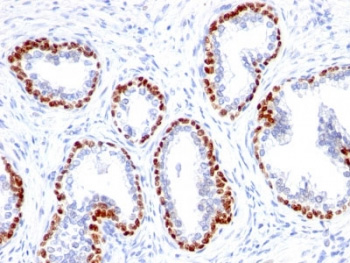
p63 Antibody Immunohistochemistry (IHC) in Human Tissue. Immunohistochemistry analysis of p63 / TP63 expression in formalin-fixed, paraffin-embedded human prostate cancer tissue using a recombinant p63 antibody (clone TP63/1423R). Staining shows strong nuclear HRP-DAB brown signal in basal-type epithelial cells, while surrounding stromal cells remain largely negative, with hematoxylin counterstain highlighting tissue morphology. This image demonstrates the use of IHC antibodies for tissue-based protein detection, epithelial cell identification, and cancer biomarker analysis in pathology research.


 info@nsjbio.com