- Tel: 858.663.9055
 Email: info@nsjbio.com
- Tel: 858.663.9055
- Email: info@nsjbio.com
Email: info@nsjbio.com
Marker of proliferation Ki-67 (MKI67), commonly referred to as Ki67, is a nuclear protein associated with active cell division and is widely used as a marker of cellular proliferation. The Ki67 antibody is commonly used in research to evaluate growth activity in normal and cancer tissues, where its expression reflects the proportion of actively dividing cells. Because Ki67 is present during all active phases of the cell cycle and absent in quiescent cells, it serves as a reliable indicator of proliferative status.
Ki67 antibody, also known as MKI67 antibody or proliferation marker antibody, enables detection of nuclear protein expression across a wide range of tissues and experimental systems. Ki67 localization is confined to the nucleus during cell cycle progression, producing distinct staining patterns that correlate with cellular proliferation. In tumor biology, Ki67 expression is often evaluated alongside p53 tumor suppressor antibody to compare proliferative activity with regulatory checkpoint control.
Ki67 is expressed during G1, S, G2, and M phases of the cell cycle but is absent in resting (G0) cells, making it a highly specific marker of active proliferation. Ki67 antibody supports studies of cell cycle dynamics by identifying populations of cells that are actively progressing through division. This makes it a valuable tool for analyzing tissue growth, regeneration, and experimental perturbations affecting cell proliferation.
Ki67 is widely used in cancer research to assess tumor growth rate and biological aggressiveness. Elevated Ki67 expression is often associated with increased proliferation and more aggressive tumor behavior. Ki67 antibody enables analysis of these patterns across tumor types and is frequently used in conjunction with structural and lineage markers such as cytokeratin epithelial marker antibodies to better understand tumor composition and origin.
Beyond oncology, Ki67 plays an important role in developmental biology and tissue regeneration. Ki67 antibody enables identification of proliferating cells in normal tissues, supporting studies of stem cell activity, tissue repair, and growth regulation. Its expression provides insight into how tissues maintain and restore cellular populations.
Ki67 is also used to study cellular turnover and stem cell dynamics, where distinguishing between proliferating and quiescent populations is critical. Ki67 antibody supports investigation of these processes by enabling detection of actively dividing cells across a wide range of biological contexts.
Due to its strong association with cell division, Ki67 remains one of the most widely used proliferation markers in biomedical research. Ki67 antibody provides a reliable tool for assessing cell cycle activity and understanding biological processes driven by cellular growth.
For additional antibody categories and targets, explore our antibody overview page.
Please find a sampling of the Ki67 antibodies available from NSJ Bioreagents below.
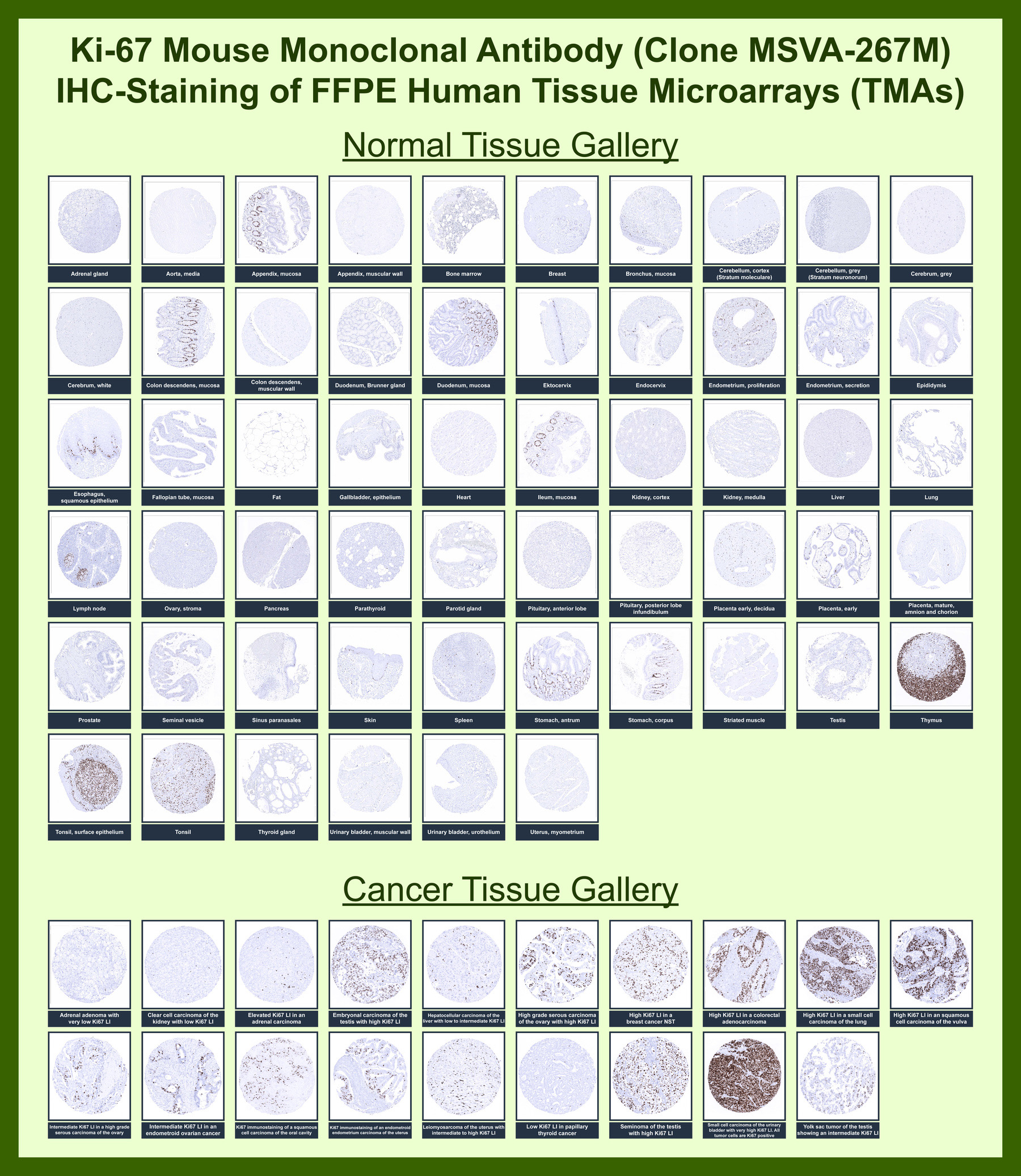
Ki67 Antibody for IHC. Immunohistochemistry analysis of Ki67 / MKI67 expression in human tissue microarray (TMA) using Ki67 antibody clone MSVA-267M. FFPE human tissue microarrays containing a broad range of normal and cancer tissues show nuclear HRP-DAB brown staining in proliferating cell populations, consistent with the expected nuclear localization of the Ki67 proliferation marker. In normal tissues, staining is largely confined to physiologic proliferative compartments including germinal centers, basal epithelial layers, and intestinal crypts, while most differentiated tissues exhibit minimal signal. In cancer tissues, many carcinomas demonstrate increased fractions of Ki67-positive nuclei, reflecting elevated cellular proliferation. The staining pattern aligns with established MKI67 expression profiles and supports the use of Ki67 antibody for tumor proliferation analysis and cancer biomarker research.


 Powered by Bioz



 info@nsjbio.com