- Tel: 858.663.9055
 Email: info@nsjbio.com
- Tel: 858.663.9055
- Email: info@nsjbio.com
Email: info@nsjbio.com
CD3 antigen (CD3) is a multi-subunit protein complex expressed on the surface of T lymphocytes, where it plays a central role in T cell receptor (TCR) signaling and immune activation. The CD3 complex is composed of several chains, including CD3 epsilon (CD3E), CD3 delta (CD3D), and CD3 gamma (CD3G), which function together to regulate antigen recognition and downstream signaling events. Because of its essential role in T cell biology, CD3 antibody reagents are widely used for identifying T cell populations, studying immune responses, and characterizing lymphoid tissues.
Among these subunits, detection using CD3 epsilon antibody is the most widely applied approach for identifying T cells in both tissue-based and cell-based assays. CD3 antibody is one of the most commonly used markers in immunology and pathology, particularly in studies involving T cell development, activation, and immune-mediated disease.
Detection of CD3 allows researchers to distinguish T cells from other immune cell populations and to evaluate immune infiltration in tissues, including tumor microenvironments. These properties make CD3 a foundational marker in both basic research and clinical investigation.
The CD3 complex consists of multiple subunits that associate with the T cell receptor to form a functional signaling unit. These include the CD3 epsilon, CD3 delta, and CD3 gamma chains, each contributing to receptor assembly, stability, and intracellular signaling.
The CD3 epsilon chain plays a central role in signal transduction and is the most widely studied and commonly targeted subunit. Detection using CD3 epsilon antibody is therefore frequently used as a primary method for identifying T cell populations in tissue sections and cell-based assays.
Additional subunits such as CD3 delta and CD3 gamma contribute to the structural and functional integrity of the TCR complex. Targeted detection using CD3 delta antibody and CD3 gamma antibody enables more detailed analysis of T cell receptor composition and subunit-specific expression patterns.
CD3 antibody for IHC is widely used to identify T lymphocytes in formalin-fixed, paraffin-embedded tissues. Immunohistochemical staining typically shows membranous localization in T cells, allowing clear visualization of lymphocyte distribution within tissues.
In normal tissues, CD3 staining highlights T cell populations in lymphoid organs such as tonsil, lymph node, and thymus. In tumor samples, CD3 antibody is commonly used to evaluate tumor-infiltrating lymphocytes, providing insight into immune response and tumor microenvironment composition.
Detection using CD3 epsilon antibody is the most common approach for IHC applications due to its robust and consistent expression across T cell populations.
CD3 antibody is a key reagent in flow cytometry for identifying and isolating T cell populations. Surface staining allows precise quantification of CD3-positive cells and enables detailed immune profiling across experimental conditions.
Flow cytometry using CD3 antibody is widely applied in immunology, oncology, and clinical research to assess immune cell composition, activation status, and response to treatment. Because CD3 is expressed on nearly all mature T cells, it serves as a reliable marker for defining total T cell populations.
CD3 antibody for western blot is used to detect expression of CD3 subunits and to study T cell receptor signaling components. Depending on the subunit targeted, western blot analysis may reveal distinct bands corresponding to CD3 epsilon, delta, or gamma chains.
This application supports investigation of T cell signaling pathways, receptor assembly, and protein expression changes under different experimental conditions. Subunit-specific detection using CD3 epsilon, CD3 delta, or CD3 gamma antibodies enables more detailed analysis of TCR complex biology.
CD3 antibody reagents are used across a wide range of applications in immunology and disease research.
Researchers use CD3 antibody to:
- Identify and quantify T cell populations
- Evaluate immune infiltration in tumor tissues
- Study T cell activation and signaling pathways
- Characterize lymphoid tissue organization
- Monitor immune responses in infection and autoimmune disease
These applications make CD3 a critical marker for understanding immune system function and disease-related immune changes.
CD3 plays a central role in both research and clinical settings. In immunology, CD3 antibody is used to define T cell populations and to study immune activation. In oncology, it is widely applied to evaluate tumor-infiltrating lymphocytes and immune responses within the tumor microenvironment.
Clinically, CD3 is a standard marker in diagnostic pathology for identifying T cell lineage in lymphomas and other hematological malignancies. Reliable detection of CD3 supports accurate classification of disease and informs treatment decisions.
CD3 antibody is an essential tool for studying T cell biology, immune responses, and disease-related changes across multiple biological systems. By targeting components of the T cell receptor complex, CD3 antibodies enable precise identification and analysis of T lymphocytes in both research and clinical contexts.
Explore our selection of CD3 epsilon antibody, CD3 delta antibody, and CD3 gamma antibody to support a wide range of immunology and oncology applications.
For a broader selection of related markers, explore our CD Antibodies page covering cluster of differentiation proteins used in immune profiling and cancer research.
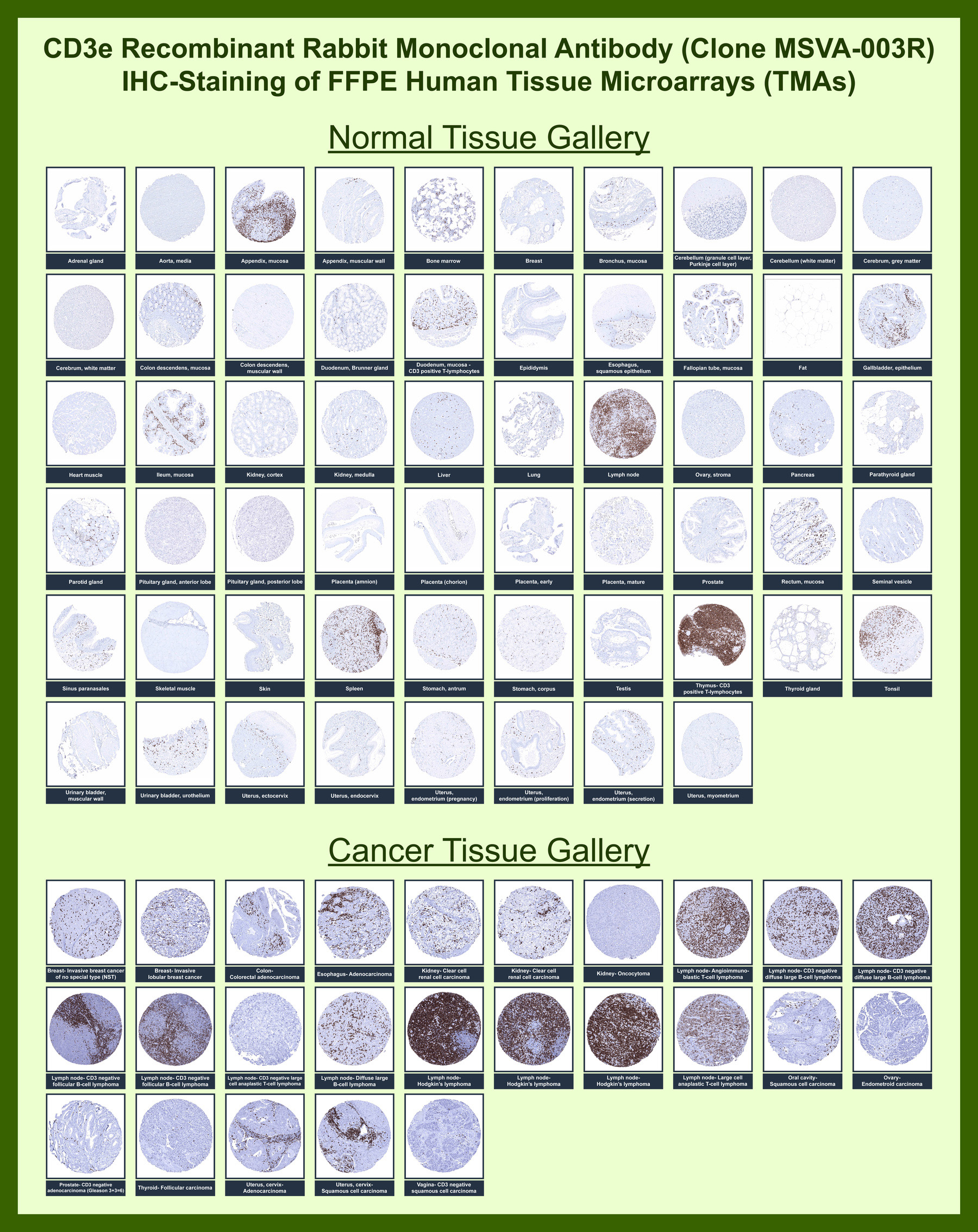
CD3 Antibody Tissue Microarray (TMA) IHC. Immunohistochemistry analysis of CD3 / CD3 antigen expression across human tissue microarrays containing a wide range of normal and cancer tissues using antibody. Strong HRP-DAB brown membranous and cytoplasmic staining highlights T lymphocytes in lymphoid-rich tissues such as tonsil, lymph node, and spleen, while most non-lymphoid tissues show minimal background signal. In cancer samples, variable densities of CD3-positive tumor-infiltrating lymphocytes are observed, reflecting differences in immune cell infiltration across tumor types. This staining pattern supports the use of CD3 antibody as a marker for T cell distribution, immune contexture, and tumor-associated immune responses in FFPE tissue microarrays.


 Powered by Bioz



 info@nsjbio.com