- Tel: 858.663.9055
 Email: info@nsjbio.com
- Tel: 858.663.9055
- Email: info@nsjbio.com
Email: info@nsjbio.com
Pan Cytokeratin Antibody reagents are widely used to identify epithelial cells across a broad range of normal and cancer tissues. Cytokeratins are intermediate filament proteins expressed in epithelial cells, where they provide structural support and help maintain tissue integrity. Because different epithelial tissues express distinct combinations of cytokeratin isoforms, antibodies that recognize multiple keratin proteins are essential for comprehensive epithelial detection. Pan cytokeratin antibody reagents are designed to detect both type I and type II cytokeratins, enabling broad identification of epithelial lineage in immunohistochemistry applications.
Pan Cytokeratin Antibody reagents are particularly valuable for distinguishing epithelial-derived tumors from non-epithelial malignancies. In immunohistochemistry, strong cytoplasmic staining highlights epithelial tumor cells within complex tissue environments, allowing clear visualization of carcinoma structures such as glands, nests, and sheets of malignant cells. This makes pan cytokeratin antibodies a foundational tool for identifying carcinomas and assessing tumor architecture in tissue sections.
Pan cytokeratin antibodies recognize a wide range of keratin proteins spanning both low molecular weight and high molecular weight cytokeratins. These include keratins commonly expressed in simple epithelia, stratified epithelia, and glandular tissues. By targeting multiple keratin isoforms simultaneously, pan cytokeratin antibody reagents provide broad epithelial coverage that is not limited to a single tissue type or differentiation state.
This broad-spectrum detection differs from isoform-specific keratin antibodies such as CK7, CK20, or KRT77, which are used to define particular epithelial subtypes or differentiation patterns. Pan cytokeratin antibodies instead provide a comprehensive overview of epithelial distribution, making them especially useful for initial tissue characterization and epithelial lineage identification.
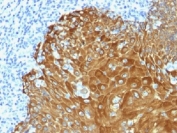
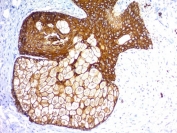
Pan Cytokeratin Antibody performance is well demonstrated in tissue microarray (TMA) analysis, where large panels of normal and cancer tissues are evaluated under identical conditions. In these studies, pan cytokeratin staining consistently highlights epithelial compartments across diverse organs, including glandular, ductal, and stratified epithelial structures. Non-epithelial components such as stromal, mesenchymal, and immune cells remain largely negative, providing strong contrast and facilitating interpretation.
In cancer tissue microarrays, pan cytokeratin antibodies are particularly useful for identifying epithelial tumor cells and defining tumor boundaries. The staining pattern enables visualization of tumor architecture and supports analysis of tumor distribution within complex microenvironments. This makes pan cytokeratin detection a valuable approach for large-scale tissue profiling and comparative studies.
While pan cytokeratin antibodies provide broad epithelial coverage, keratin-specific antibodies are used to analyze individual keratin proteins associated with specific tissues or differentiation states. For example, antibodies targeting CK7, CK20, or KRT77 provide more selective information about epithelial subtype identity. In contrast, pan cytokeratin antibodies are designed for inclusive epithelial detection and are typically used as a first-line tool for identifying epithelial lineage before applying more specialized markers.
Pan Cytokeratin Antibody reagents are widely used in immunohistochemistry to evaluate epithelial tissue distribution, identify epithelial tumor cells, and study tissue architecture. Their broad reactivity makes them suitable for analyzing complex samples where epithelial and non-epithelial components must be clearly distinguished. By providing strong and consistent staining across epithelial tissues, pan cytokeratin antibodies support reliable interpretation of histologic and experimental data.
Pan Cytokeratin Antibody reagents therefore serve as a foundational tool for epithelial detection, enabling comprehensive analysis of epithelial distribution, carcinoma identification, and tissue organization across a wide range of biological and research applications.
Researchers studying epithelial tumor identification, carcinoma lineage characterization, and epithelial differentiation pathways may also be interested in our Cancer Antibodies landing page featuring tumor biomarkers, signaling mediators, and oncology related targets.
These antibodies are part of a broader antibody panel offered by NSJ Bioreagents.
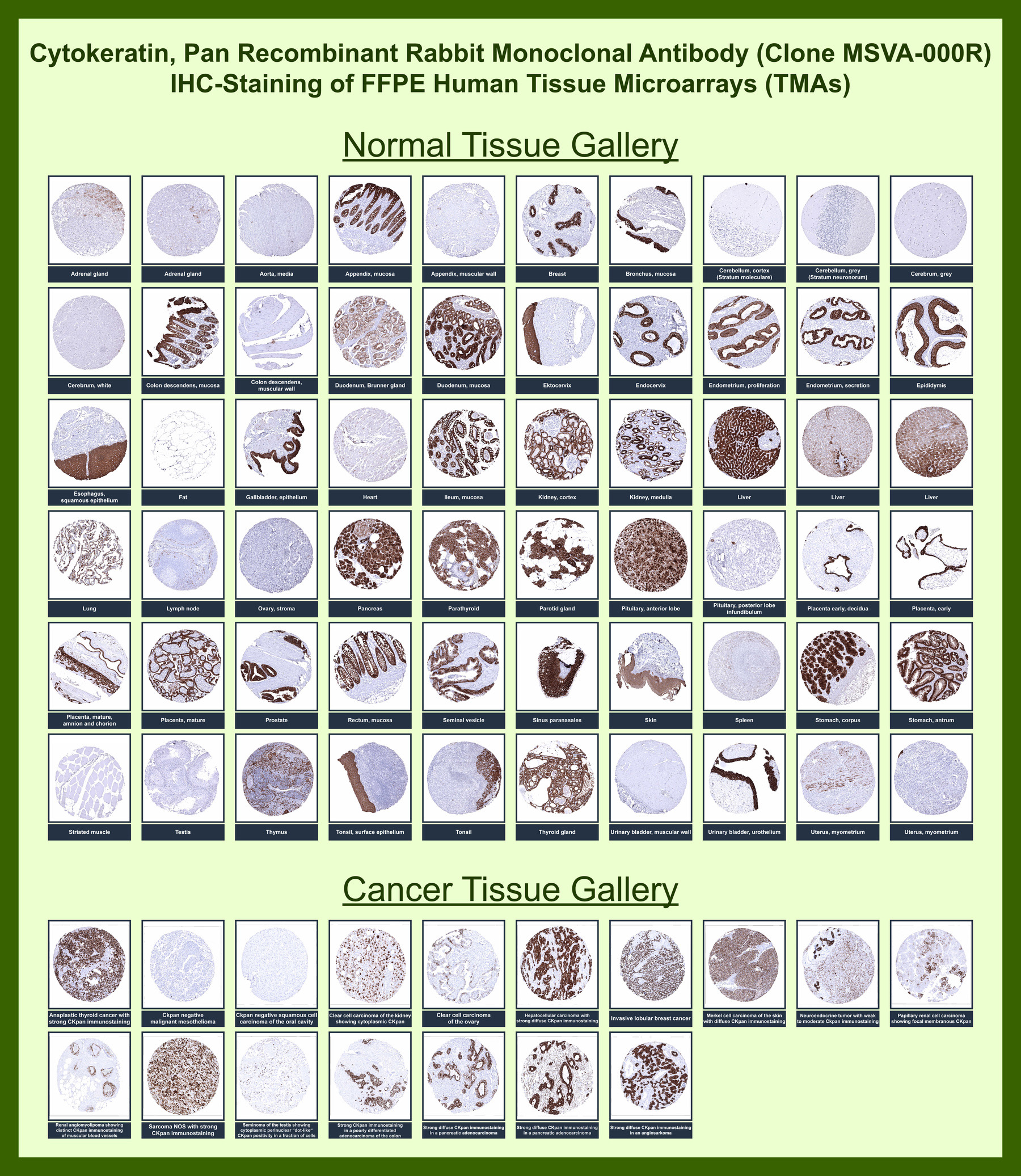
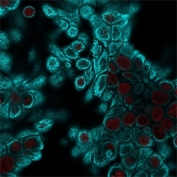
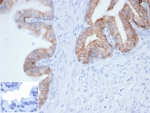
Pan Cytokeratin Antibody human tissue microarray (TMA) IHC. Immunohistochemistry analysis of cytokeratin expression in formalin-fixed, paraffin-embedded human tissue microarray using Pan Cytokeratin Antibody MSVA-000R. The human tissue microarray (TMA) contains a broad range of normal and cancer tissues, enabling comprehensive evaluation of epithelial distribution. Strong cytoplasmic HRP-DAB brown staining is observed across epithelial compartments including glandular, ductal, and stratified epithelia, while stromal, mesenchymal, and lymphoid tissues remain largely negative. In cancer tissues, diffuse staining highlights epithelial tumor cells and clearly delineates carcinoma structures within complex tumor microenvironments.
| ||

|


 Citations (12)
 Powered by Bioz




 info@nsjbio.com