- Tel: 858.663.9055
 Email: info@nsjbio.com
- Tel: 858.663.9055
- Email: info@nsjbio.com
Email: info@nsjbio.com
Zebrafish antibody reagents are widely used for protein detection in Danio rerio, a well-established vertebrate model organism in developmental biology, genetics, and disease research. Primary antibodies enable analysis of protein expression, localization, and function in zebrafish tissues and embryos, supporting studies of organ development, cellular differentiation, and signaling pathways. These approaches are commonly applied to identify proliferating cell populations using PCNA proliferation marker antibody.
Zebrafish (Danio rerio) provides a powerful system for studying vertebrate biology due to its genetic conservation, optical transparency during early development, and rapid embryogenesis. Zebrafish antibodies are used to investigate protein expression patterns across tissues and developmental stages, enabling detailed analysis of cell lineage specification, tissue organization, and dynamic biological processes in vivo.
Zebrafish antibodies are extensively used to study embryonic development, where protein expression patterns define cell fate, tissue formation, and organogenesis. These antibodies enable detection of transcription factors, signaling molecules, and structural proteins involved in early developmental stages. Key developmental pathways are frequently studied using markers such as Sonic Hedgehog signaling antibody, which plays a central role in embryonic patterning and morphogen-driven tissue organization.
Zebrafish antibodies are also used to examine tissue architecture and cellular organization during development and in mature tissues. Structural proteins that regulate cell adhesion and epithelial integrity are commonly analyzed to understand how tissues form and maintain organization. Markers such as E-cadherin epithelial marker antibody are widely used to study cell-cell adhesion and epithelial layer formation in zebrafish models.
Zebrafish is widely used to model human diseases including cancer, neurological disorders, and cardiovascular conditions. Zebrafish antibodies support these studies by enabling visualization of protein expression changes associated with disease progression, injury response, and regeneration. Proteins involved in stress response and tumor biology, such as p53 tumor suppressor antibody, are commonly studied to investigate cellular responses to damage and transformation.
Zebrafish antibodies enable detailed analysis of protein localization within cells and tissues, supporting imaging-based studies of developmental and disease processes. These approaches are commonly used in immunofluorescence and whole-mount staining to visualize spatial and temporal patterns of protein expression in the zebrafish model. Such methods provide insight into how proteins function within specific cellular compartments during embryogenesis and tissue development.
Zebrafish antibodies support a wide range of research applications including protein detection, tissue analysis, and imaging-based studies in the zebrafish model. These tools enable investigation of gene function, developmental pathways, and disease-associated protein expression in Danio rerio.
This Zebrafish Developmental Marker antibody page is part of a broader zebrafish antibody panel offered by NSJ Bioreagents.
Browse the complete collection of research antibodies on our Antibodies landing page.
A selection of zebrafish antibody products is shown below to support a range of research applications.
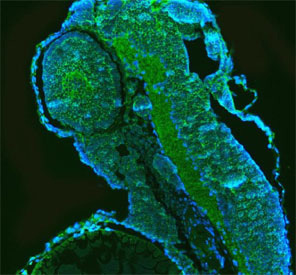
Zebrafish Gnb1 Antibody Embryo Immunofluorescence (IF). Immunofluorescence analysis of Gnb1 expression in Danio rerio embryo tissue using zebrafish Gnb1 antibody. FFPE zebrafish embryo sections show cytoplasmic and membrane-associated fluorescence signal (green) within developing embryonic structures, consistent with the role of guanine nucleotide-binding protein subunit beta 1 in signal transduction pathways. DAPI nuclear counterstain (blue) highlights overall tissue architecture. This image demonstrates the use of zebrafish antibodies for protein localization, signaling pathway analysis, and developmental biology studies in the zebrafish model.
| ||

|


 Powered by Bioz


 info@nsjbio.com