- Tel: 858.663.9055
 Email: info@nsjbio.com
- Tel: 858.663.9055
- Email: info@nsjbio.com
Email: info@nsjbio.com
IgA1 antibody detection is essential for studying systemic immunoglobulin responses and subclass-specific immune regulation. Immunoglobulin alpha 1 (IgA1) is the predominant IgA subclass in human circulation and plays a central role in serum antibody responses. Accurate detection of IgA1 is critical for understanding immune status, antibody production, and disease-associated immunoglobulin patterns.
IgA1 Antibody for ELISA applications enables selective quantification of immunoglobulin alpha 1 in serum, plasma, and other biological samples. These antibodies are widely used in immunology research, clinical investigations, and antibody profiling studies where subclass-specific detection is required.
IgA1 is structurally distinguished from IgA2 by an extended hinge region rich in proline, serine, and threonine residues. This hinge region provides flexibility for antigen binding and supports formation of immune complexes, but also increases susceptibility to proteolytic cleavage by bacterial enzymes.
Functionally, IgA1 is primarily associated with systemic immune responses and circulates at higher levels than IgA2. It plays a role in antigen neutralization, immune complex formation, and antibody-mediated immune signaling. Due to its abundance in serum, IgA1 is commonly used as a marker of circulating antibody responses.
IgA1 Antibody for ELISA systems are optimized for sensitive and selective detection of immunoglobulin alpha 1 in complex biological samples. These assays support:
Because IgA1 is the dominant circulating IgA subclass, its detection provides critical insight into systemic immune activity. Subclass-specific antibodies are essential for distinguishing IgA1 from IgA2 in ELISA-based assays.
IgA1 and IgA2 differ significantly in structure and function, making subclass-specific detection important for accurate immune analysis.
IgA1 contains an extended hinge region, while IgA2 has a shorter, more protease-resistant structure. These differences influence their distribution, stability, and biological roles.
Subclass-specific antibodies allow researchers to distinguish between systemic and mucosal immune responses, improving the resolution of ELISA-based immunoglobulin analysis.
IgA1 antibodies are widely used in:
IgA1 is frequently associated with circulating immune complexes and has been implicated in conditions such as IgA nephropathy, making it an important target for immunological investigation.
IgA1 antibodies provide essential tools for studying systemic immune responses and subclass-specific immunoglobulin dynamics. Their ability to selectively detect immunoglobulin alpha 1 enables precise analysis of antibody production, immune status, and disease-associated immune changes.
Explore our immunoglobulin antibody collection to find IgA, IgA1, and IgA2 antibodies optimized for ELISA-based detection and subclass-specific analysis.
Researchers studying immunoglobulin subclass detection, mucosal immune responses, and ELISA based antibody quantification assays may also be interested in our Immunology Antibodies landing page featuring cytokines, immune markers, and host defense related proteins.
Browse the complete collection of research antibodies on our Antibodies landing page.
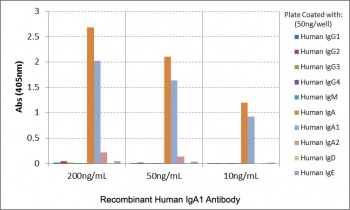
Human IgA1 Antibody for ELISA Subclass Specificity Analysis. ELISA analysis of human immunoglobulins demonstrates that clone RM124 selectively recognizes Human IgA1 / IGHA1, with strong signal observed across tested concentrations, indicating specific binding to the alpha 1 heavy chain




 Powered by Bioz


 info@nsjbio.com