- Tel: 858.663.9055
 Email: info@nsjbio.com
- Tel: 858.663.9055
- Email: info@nsjbio.com
Email: info@nsjbio.com
Cardiovascular Antibodies are essential reagents for exploring the molecular pathways that govern heart function, vascular biology, and blood circulation. Cardiovascular research investigates how cardiomyocytes, endothelial cells, vascular smooth muscle cells, and circulating immune cells coordinate to maintain cardiovascular homeostasis. Dysregulation of these systems contributes to leading global health burdens, including atherosclerosis, myocardial infarction, hypertension, arrhythmias, and heart failure.
The targets of cardiovascular research span structural proteins, ion channels, adhesion molecules, cytokines, growth factors, and enzymes that regulate vascular tone, cardiac contractility, and immune–vascular interactions. The Cardiovascular Antibodies collection provides reliable detection of these proteins, enabling researchers to map disease mechanisms, validate biomarkers, and explore therapeutic strategies.
NSJ Bioreagents offers Cardiovascular Antibodies validated for immunohistochemistry, western blotting, flow cytometry, immunofluorescence, and ELISA. Each Cardiovascular Antibody is subjected to rigorous quality control to ensure specificity, reproducibility, and compatibility across diverse assay platforms.
By selecting Cardiovascular Antibodies from NSJ Bioreagents, scientists gain reagents optimized for clarity and consistency. Our antibodies provide strong staining in cardiac and vascular tissues, reproducible detection in lysates, and robust performance in both discovery and diagnostic workflows. Comprehensive datasheets, validated controls, and optimized protocols further ensure reproducibility in both laboratory and translational settings.
The Cardiovascular Antibodies collection supports diverse applications across cardiovascular biology and disease.
Cardiovascular Antibodies detect contractile proteins like troponins, myosin heavy chains, and actin isoforms.
The Cardiovascular Antibodies support studies of cardiomyocyte differentiation and hypertrophy.
Antibodies help clarify mechanisms of contractile dysfunction in heart failure.
Cardiovascular Antibodies highlight adhesion molecules, integrins, endothelial markers such as CD31 / PECAM1, and vascular smooth muscle proteins involved in angiogenesis and vascular remodeling.
The Cardiovascular Antibodies support research into endothelial activation and plaque formation.
Antibodies validate biomarkers for vascular remodeling and atherogenesis.
Cardiovascular Antibodies detect cytokines, chemokines, and immune cell markers in vascular disease.
The Cardiovascular Antibodies support studies of immune–vascular cross-talk.
Antibodies clarify mechanisms of chronic inflammation in cardiovascular pathology.
Cardiovascular Antibodies identify sodium, potassium, and calcium ion channel proteins involved in cardiac conduction, arrhythmogenesis, and electrophysiologic signaling pathways. Researchers studying these regulatory networks may also be interested in our Signal Transduction Antibodies landing page featuring kinases, adaptor proteins, and intracellular signaling mediators.
The Cardiovascular Antibodies support studies of arrhythmias and conduction disorders.
Antibodies provide tools for mapping ion channel dysregulation in disease.
Cardiovascular Antibodies detect extracellular matrix proteins and remodeling enzymes.
The Cardiovascular Antibodies support research into fibrosis after myocardial infarction.
Antibodies validate therapeutic strategies targeting tissue repair.
Cardiovascular Antibodies are integrated into biomarker-driven cardiovascular studies.
The Cardiovascular Antibodies support patient stratification in clinical trials.
Antibodies ensure reproducibility and reliability in translational workflows.
Cardiovascular biology connects molecular pathways with systemic health outcomes. The Cardiovascular Antibodies portfolio equips researchers to investigate proteins critical for heart and vascular function.
In cardiac research, Cardiovascular Antibodies highlight contractile proteins and biomarkers of heart injury. In vascular biology, they identify molecules involved in endothelial activation and atherosclerosis. In immunology, the Cardiovascular Antibodies clarify immune–vascular interactions driving chronic disease.
Clinically, cardiovascular biomarkers remain indispensable for diagnosis, prognosis, and therapeutic monitoring. Reliable Cardiovascular Antibodies ensure reproducibility, bridging basic science with translational and clinical medicine.
Cardiovascular disease remains the leading cause of morbidity and mortality worldwide, and antibodies are key tools for advancing understanding and treatment. The Cardiovascular Antibodies collection provides validated reagents for studying heart and vascular biology across basic research, diagnostics, and translational applications. By ensuring specificity, reproducibility, and assay versatility, these antibodies remain indispensable for advancing cardiovascular science and improving clinical outcomes.
Researchers studying endothelial signaling, vascular remodeling, and angiogenesis pathways may also be interested in our Angiogenesis Antibodies landing page featuring endothelial markers, adhesion proteins, and vascular growth regulators.
Browse the complete collection of research antibodies on our Antibodies landing page.
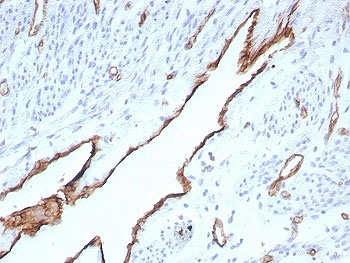
CD31 Antibody Placental Vasculature IHC. Immunohistochemistry staining of FFPE human placental tissue with CD31 Antibody / PECAM1 Endothelial Cell Marker clone rPECAM1/8832 demonstrates strong membranous HRP-DAB brown staining of vascular endothelial cells lining placental blood vessels and microvascular structures. The staining pattern highlights the extensive endothelial network characteristic of highly vascular placental tissue and is consistent with the established role of CD31 / PECAM1 in vascular adhesion, endothelial integrity, and angiogenesis related cardiovascular biology. HIER: boil tissue sections in pH 9 10mM Tris with 1mM EDTA for 20 min and allow to cool before testing.

| ||

|


 Powered by Bioz




 info@nsjbio.com