- Tel: 858.663.9055
 Email: info@nsjbio.com
- Tel: 858.663.9055
- Email: info@nsjbio.com
Email: info@nsjbio.com
Histone H3 antibodies for chromatin and epigenetics research are essential tools for studying nucleosome organization, chromatin structure, and regulation of gene expression. Histone H3 (HIST1H3A) is a central component of the nucleosome and serves as a primary platform for post-translational modifications that control chromatin accessibility, transcriptional activity, and genome stability. This collection of Histone H3 antibodies provides a comprehensive resource for detecting total H3, histone variants, and modification-specific chromatin states.
Histone H3 is extensively modified at multiple lysine residues, generating a complex regulatory system that governs gene expression and chromatin dynamics. These modifications include methylation, acetylation, phosphorylation, and emerging acylation marks such as crotonylation. Targeted reagents such as H3K27ac antibody, H3K9me2 antibody, and H3K4me2 antibody enable precise analysis of chromatin states associated with gene activation, repression, and transcriptional regulation. Together, these Histone H3 antibodies allow researchers to define functional chromatin landscapes across diverse biological systems.
In addition to single modifications, combinatorial histone marks and modification-specific variants contribute to chromatin complexity. Tools such as H3K9me2/K14ac antibody support investigation of chromatin state transitions, while modification-independent reagents including Histone H3 antibody provide normalization and reference controls for epigenetic analysis. Variant-specific and modification-specific antibodies are widely used to study transcriptional regulation, chromatin remodeling, and genome stability.
Histone H3 antibodies are used to detect core histone proteins and a wide range of regulatory modifications, including:
These targets collectively support investigation of chromatin structure, epigenetic regulation, and gene expression control across normal and disease contexts.
These Histone H3 antibodies are widely used to investigate chromatin organization, histone modification dynamics, and epigenetic regulation, providing essential tools for studying transcriptional control, genome stability, and chromatin-based regulatory mechanisms.
Researchers studying chromatin regulation, histone modification pathways, and epigenetic transcriptional control may also be interested in our Cell Biology Antibodies landing page featuring nuclear markers, intracellular regulators, and signaling related targets.
Browse the complete collection of research antibodies on our Antibodies landing page.
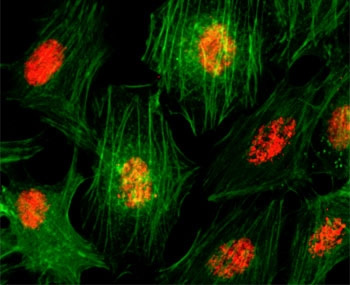
Histone H3 Antibodies. Immunofluorescence analysis of Histone H3 in human cells using a Histone H3 antibody shows strong nuclear staining consistent with chromatin-associated localization. Nuclear signal reflects distribution of Histone H3 within nucleosomes, supporting its role in chromatin organization and epigenetic regulation, while cytoplasmic structures provide morphological context.




 Powered by Bioz



 info@nsjbio.com