- Tel: 858.663.9055
 Email: info@nsjbio.com
- Tel: 858.663.9055
- Email: info@nsjbio.com
Email: info@nsjbio.com
Renal Cell Antibodies are valuable tools for investigating kidney development, nephron organization, epithelial cell biology, and renal disease mechanisms. The kidney contains highly specialized cell populations that regulate filtration, electrolyte balance, acid-base homeostasis, and fluid regulation. Antibodies directed against renal cell markers enable researchers to identify distinct cellular compartments and evaluate proteins involved in normal kidney physiology and disease-associated processes.
Renal epithelial cells are responsible for many of the essential functions of the kidney and are commonly studied in developmental biology, physiology, pathology, and regenerative medicine research. As a result, renal cell antibodies play important roles in investigations of kidney structure, cellular differentiation, and tissue-specific protein expression.
The kidney contains numerous specialized epithelial cell populations distributed throughout the nephron. These include glomerular cells, proximal tubular epithelial cells, distal tubular epithelial cells, collecting duct cells, and other highly differentiated populations that contribute to renal function.
Each renal compartment expresses characteristic proteins that support filtration, transport, absorption, secretion, and metabolic regulation. Antibodies directed against renal cell markers help researchers distinguish these cellular populations and investigate the molecular pathways that regulate kidney homeostasis.
Because renal epithelial cells are highly metabolically active and respond dynamically to physiologic stress, they are frequently studied in models of tissue injury, fibrosis, inflammation, and regeneration.
Frequently studied renal cell-associated proteins include:
These markers help characterize specific nephron segments, renal epithelial differentiation states, and disease-associated cellular changes.
Renal cell biology is central to the study of acute kidney injury, chronic kidney disease, fibrosis, inherited renal disorders, and renal neoplasms. Changes in protein expression within kidney epithelial cells can provide important insight into disease progression and tissue remodeling.
Researchers frequently utilize renal cell antibodies to investigate cellular responses to injury, inflammatory signaling pathways, epithelial plasticity, and molecular mechanisms that contribute to kidney dysfunction. These studies continue to improve understanding of renal physiology and disease-associated biological processes.
Renal Cell Antibodies are commonly used for:
These antibodies support investigations into both normal renal physiology and disease-associated changes in kidney tissue.
The Renal Cell Antibody collection includes antibodies directed against proteins involved in nephron organization, epithelial differentiation, transport regulation, cellular homeostasis, and kidney-specific biological pathways. These reagents support studies of renal development, kidney physiology, tissue injury, and disease-associated molecular mechanisms.
Researchers studying epithelial differentiation, tissue-specific cellular organization, and organ system biology may also be interested in our Cell Biology Antibodies landing page featuring intracellular regulators, structural proteins, and signaling related targets.
Browse the complete collection of research antibodies on our Antibodies landing page.

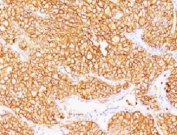
Carbonic Anhydrase 9 Antibody Renal Cell Carcinoma IHC. Immunohistochemistry analysis of FFPE human renal cell carcinoma tissue using recombinant Carbonic Anhydrase 9 Antibody clone CA9/2993R demonstrates strong HRP-DAB brown membranous staining throughout tumor epithelial cell populations. The staining pattern is consistent with the established cell surface localization of Carbonic anhydrase 9 (CA9), a hypoxia-responsive transmembrane enzyme involved in pH regulation, cellular adaptation to low oxygen environments, and renal epithelial tumor biology. This image highlights robust tumor-associated CA9 expression and supports studies of renal cell carcinoma, hypoxia signaling, and kidney epithelial cell markers. HIER: boil tissue sections in pH6, 10mM citrate buffer, for 10-20 min and allow to cool before testing.


 Citations (1)
 Powered by Bioz





 info@nsjbio.com