- Tel: 858.663.9055
 Email: info@nsjbio.com
- Tel: 858.663.9055
- Email: info@nsjbio.com
Email: info@nsjbio.com
Melan A (MLANA), also known as MART-1, is a melanocyte-specific protein involved in melanosome formation and pigment production. It is selectively expressed in melanocytes and melanocyte-derived tumors, making it one of the most widely used markers for identifying melanocytic lineage. Melan A antibody reagents are commonly used in research to detect melanocyte populations and study melanoma biology across tissue and cell-based systems.
Melan A expression is tightly linked to melanocyte identity and differentiation, with cytoplasmic localization in pigment-producing cells. Because of its highly restricted expression pattern, Melan A antibody staining provides strong contrast between melanocytic cells and surrounding epithelial, stromal, and immune cell populations, supporting accurate identification of melanocyte-derived cells in complex tissues.
Melan A is a definitive marker of melanocyte lineage, reflecting the specialized biology of neural crest-derived pigment cells. Its expression increases as precursor cells commit to the melanocytic lineage and mature into functional melanocytes. This makes Melan A antibody detection a reliable tool for evaluating lineage identity, differentiation status, and cellular origin.
In research applications, Melan A antibody is used to:
The restricted expression profile of Melan A enhances specificity and reduces background staining in heterogeneous samples.
Melan A is frequently referred to as MLANA or MART-1 in the literature, and antibodies targeting this protein are used across multiple research applications. These include immunohistochemistry for tissue analysis, immunofluorescence for cellular localization, and western blot for protein expression studies.
In tissue-based analysis, Melan A antibody staining is typically observed as cytoplasmic signal in melanocytes and melanoma cells, supporting clear visualization of melanocytic populations. In fluorescence imaging, MLANA localization highlights melanocyte morphology and distribution, while in protein-based assays, detection of MART-1 supports evaluation of melanocyte-specific expression.
Tissue Microarray (TMA) analysis enables standardized evaluation of Melan A expression across large panels of normal and cancer tissues. Melan A antibody staining in TMA datasets demonstrates highly specific cytoplasmic expression in melanocytes, with minimal staining in non-melanocytic tissues.
In cancer tissue arrays, strong Melan A expression is observed in melanoma, where staining highlights tumor cells of melanocytic origin. This consistent and reproducible staining pattern supports comparative tissue analysis and reinforces Melan A as a lineage-specific marker for melanoma research.
Melan A plays an important role in melanosome structure and pigment synthesis, linking its expression to both melanocyte function and melanoma biology. In melanoma research, Melan A antibody detection is used to evaluate tumor cell identity, differentiation status, and lineage origin.
Because Melan A expression is maintained in many melanomas, it remains a valuable marker for studying tumor biology and melanocytic differentiation. Its restricted expression profile improves interpretability in studies involving complex or heterogeneous tissue samples.
Researchers studying melanocytic differentiation, melanoma progression, and pigment cell lineage biology may also be interested in our Cancer Antibodies landing page featuring tumor biomarkers, signaling mediators, and oncology related targets.
Browse the complete collection of research antibodies on our Antibodies landing page.
A selection of Melan A antibody products is shown below to support a range of research applications.
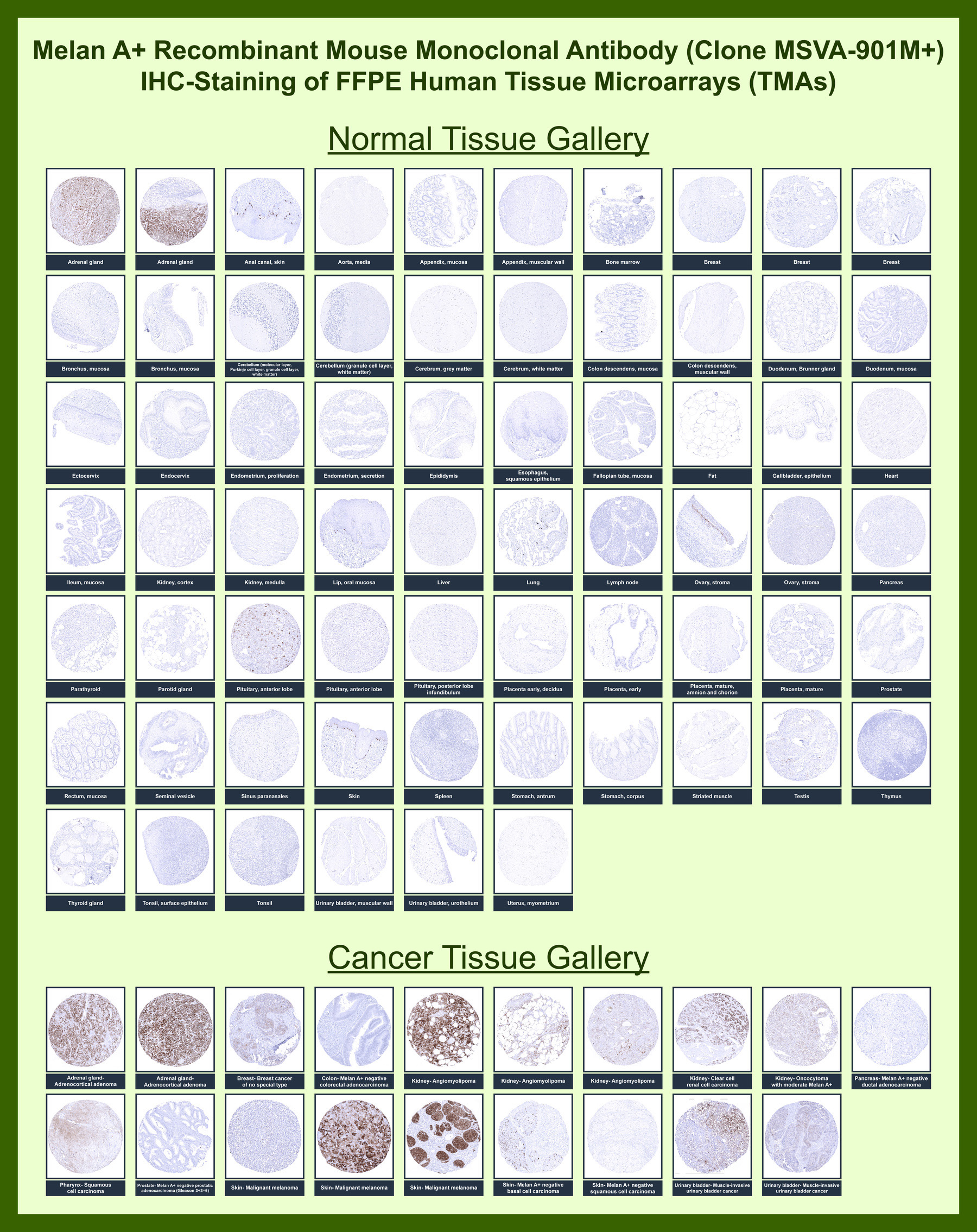
Melan A Antibody Tissue Microarray (TMA) multi-tissue expression. Analysis of Melan A (MLANA) distribution in FFPE human tissue microarray (TMA) sections using Melan A Antibody clone MSVA-901M+ demonstrates strong cytoplasmic staining in melanocytic cells and melanoma tumor samples, while non-melanocytic tissues remain largely negative. The staining pattern highlights melanocyte lineage specificity and clear contrast across diverse tissue types, consistent with known MLANA expression profiles.


 Citations (7)
 Powered by Bioz








 info@nsjbio.com