- Tel: 858.663.9055
 Email: info@nsjbio.com
- Tel: 858.663.9055
- Email: info@nsjbio.com
Email: info@nsjbio.com
Recombinant Rabbit Antibodies are engineered monoclonal antibodies generated using recombinant expression technologies designed to support highly reproducible target detection across cancer biology, immunology, neuroscience, metabolism, developmental biology, and translational pathology research applications. Recombinant Rabbit Antibodies are widely used for immunohistochemistry, western blotting, immunofluorescence, flow cytometry, immunoprecipitation, and tissue microarray analysis where consistent performance and sensitive target detection are important.
Rabbit monoclonal antibodies are frequently recognized for strong affinity toward challenging epitopes and robust detection of low-abundance targets. Recombinant rabbit monoclonal antibodies combine these biologic advantages with sequence-defined recombinant production systems that support long-term manufacturing consistency and reduced lot-to-lot variability. Because recombinant antibodies are generated from preserved immunoglobulin sequence information rather than indefinite hybridoma maintenance, recombinant rabbit antibodies are increasingly used in reproducibility-focused research environments and translational biomarker studies.
Recombinant antibody generation involves sequencing antibody variable regions from selected monoclonal clones followed by controlled recombinant expression in engineered host systems. This approach preserves antibody-binding characteristics while supporting scalable and standardized antibody production. Recombinant Rabbit Antibodies are commonly developed against:
Rabbit-derived monoclonal antibodies are often selected for detection of conformational epitopes and proteins expressed at relatively low levels within tissue or cultured cells.
Recombinant Rabbit Antibodies are commonly used in:
These antibodies are frequently used across FFPE tissue analysis, cultured cell studies, pathway signaling investigations, and disease-associated biomarker characterization.
Recombinant rabbit monoclonal antibodies are widely incorporated into cancer biology and signal transduction research due to their strong sensitivity and reproducibility characteristics. Many targets associated with:
are routinely evaluated using recombinant rabbit antibodies in tumor tissue and experimental cell systems.
Because recombinant rabbit monoclonal antibodies often demonstrate strong nuclear, membranous, or phospho-specific target detection, they are commonly used for pathway-focused biomarker studies involving proliferative signaling and disease-associated protein activation.
Sequence-defined recombinant antibody production helps preserve antibody identity and target recognition characteristics across manufacturing lots and long-term research projects. Recombinant Rabbit Antibodies are therefore increasingly used in studies emphasizing reproducibility, standardized biomarker detection, and large-scale translational validation.
The combination of recombinant production technology with rabbit monoclonal antibody affinity characteristics has made recombinant rabbit antibodies important tools across oncology, immunology, neuroscience, metabolism, stem cell biology, and epigenetic regulation research fields.
A selection of Recombinant Rabbit Antibodies products is shown below to support a range of research applications.
These antibodies are part of a broader antibody panel offered by NSJ Bioreagents.
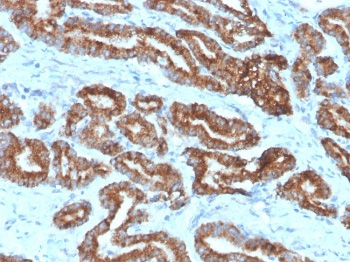
p504S Antibody Prostate Carcinoma IHC. Immunohistochemistry analysis of FFPE human prostate carcinoma tissue using p504S Antibody clone 13H4 demonstrates strong HRP-DAB brown cytoplasmic staining throughout malignant glandular epithelial cells. The staining pattern is consistent with the established expression of Alpha-methylacyl-CoA racemase (AMACR/p504S), a metabolic enzyme involved in branched-chain fatty acid metabolism and a widely studied marker in prostate cancer research. This image highlights robust tumor-associated expression within neoplastic prostate glands and supports investigations into prostate carcinoma biology and metabolic regulation. HIER: boil tissue sections in pH 9 10mM Tris with 1mM EDTA for 20 min and allow to cool before testing.




 Powered by Bioz




 info@nsjbio.com