- Tel: 858.663.9055
 Email: info@nsjbio.com
- Tel: 858.663.9055
- Email: info@nsjbio.com
Email: info@nsjbio.com
Recombinant Goat Antibodies are generated using defined antibody gene sequences that are expressed through controlled recombinant production systems. Unlike traditional antibody production approaches that rely solely on continued animal immunization or hybridoma maintenance, recombinant technologies enable antibody generation from a precisely characterized genetic template.
These reagents combine the unique antigen recognition characteristics of goat-derived antibodies with the consistency and reproducibility offered by recombinant expression systems. Recombinant Goat Antibodies are increasingly used throughout biomedical research for protein detection, biomarker characterization, cellular pathway analysis, and disease-related investigations.
Goat antibodies have long been valued for their ability to recognize targets that may be challenging in other host species. The goat immune system often generates strong responses against conserved mammalian proteins, making goat-derived antibodies useful for detecting a wide variety of biological targets.
Recombinant production further enhances these advantages by providing a defined antibody sequence that can be reproduced through controlled manufacturing processes. This approach supports long-term product consistency and helps maintain reliable target recognition across production campaigns.
Because recombinant antibodies are generated from a known genetic sequence, researchers can benefit from reproducible antibody populations that support consistent experimental performance over time.
Recombinant Goat Antibodies are used in a broad range of scientific disciplines. Their specificity and reproducibility make them useful tools for investigating proteins involved in cellular regulation, immune responses, development, metabolism, and disease progression.
Common research applications include:
These antibodies provide researchers with versatile reagents for examining protein localization, expression patterns, and biological function.
Many immune-related proteins are studied using goat-derived antibodies due to their strong antigen recognition capabilities. Recombinant Goat Antibodies are frequently used to investigate cytokines, receptors, leukocyte markers, innate immune proteins, and adaptive immune signaling pathways.
By supporting the detection of immune regulatory molecules, these antibodies contribute to studies of host defense mechanisms, inflammatory responses, antigen presentation, and immune cell differentiation.
Cellular communication depends on complex networks of receptors, signaling proteins, transcription factors, and structural molecules. Recombinant Goat Antibodies are frequently used to investigate these systems and evaluate proteins involved in cellular regulation and signal transduction.
Researchers utilize these reagents to study intracellular pathways, cell surface proteins, differentiation markers, and proteins associated with cellular organization and tissue development. Their defined sequence origin supports reproducible investigations into cellular function and disease-associated molecular mechanisms.
Reproducibility remains an important consideration across modern biomedical research. Recombinant Goat Antibodies are produced from defined antibody sequences, allowing the same molecular blueprint to be used throughout manufacturing. This approach supports long-term consistency while helping ensure reliable target recognition across production lots.
As recombinant technologies continue to expand, recombinant goat-derived antibodies provide researchers with an additional option for obtaining highly specific and reproducible antibody reagents.
The Recombinant Goat Antibody collection includes antibodies directed against proteins involved in immunology, cancer biology, cell biology, signal transduction, metabolism, neuroscience, and cardiovascular research. These reagents support investigations into protein expression, cellular regulation, biomarker discovery, and disease-associated molecular pathways.
Researchers studying immune signaling pathways, cellular communication networks, and molecular regulatory mechanisms may also be interested in our Immunology Antibodies landing page featuring cytokines, leukocyte markers, and host defense related proteins.
Browse the complete collection of research antibodies on our Antibodies landing page.
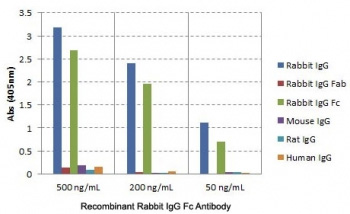
Rabbit IgG Fc Antibody Species Specificity ELISA. ELISA analysis using Rabbit IgG Fc Antibody clone RMG02 demonstrates strong, concentration-dependent recognition of rabbit IgG and rabbit IgG Fc while showing no detectable reactivity with human, mouse, or rat IgG. The results confirm selective recognition of the rabbit IgG Fc region and excellent species specificity across the tested antibody panel. This image highlights the utility of Rabbit IgG Fc Antibody reagents for accurate rabbit IgG detection, immunoglobulin quantification, and high-specificity ELISA applications requiring minimal cross-reactivity with non-rabbit species.




 Powered by Bioz





 info@nsjbio.com