- Tel: 858.663.9055
 Email: info@nsjbio.com
- Tel: 858.663.9055
- Email: info@nsjbio.com
Email: info@nsjbio.com
Recombinant antibodies are generated using defined antibody gene sequences that are expressed in controlled production systems rather than relying solely on traditional hybridoma propagation. By utilizing recombinant expression technologies, researchers gain access to antibodies produced from a precisely defined genetic template, helping support long-term consistency and reproducibility.
Recombinant antibodies have become increasingly important throughout biomedical research and are widely used in cancer biology, immunology, neuroscience, cardiovascular research, metabolism, and cell biology. Their reproducible manufacturing process and defined molecular composition make them valuable tools for protein detection, biomarker characterization, and signaling pathway analysis.
One of the primary advantages of recombinant antibody production is the ability to manufacture antibodies from a known sequence. Because the antibody is generated from a defined genetic construct, recombinant production can provide highly consistent antibody populations across manufacturing campaigns.
Recombinant technologies also enable the preservation of antibody sequences that might otherwise be difficult to maintain through traditional cell line propagation. This approach supports long-term product availability while helping reduce variability associated with biological production systems.
In addition, recombinant engineering allows researchers to generate antibodies against a broad range of targets, including cell surface proteins, intracellular proteins, transcription factors, signaling molecules, and post-translationally modified proteins.
Recombinant antibodies are widely used to investigate biological processes across numerous research disciplines. Their high specificity and reproducible production characteristics make them valuable for studies involving cellular signaling, immune regulation, development, metabolism, and disease biology.
Common research areas include:
Researchers frequently utilize recombinant antibodies to evaluate protein expression, characterize cellular pathways, identify biomarkers, and investigate disease-associated molecular mechanisms.
Many oncology-focused targets are available as recombinant antibodies. These reagents are commonly used to study proteins involved in tumor progression, cellular proliferation, angiogenesis, apoptosis, immune regulation, and therapeutic response.
Recombinant antibodies directed against tumor suppressors, oncogenes, growth factor receptors, and immune checkpoint proteins support investigations into cancer biology and biomarker discovery. Their defined sequence origin provides researchers with confidence when performing long-term studies that require consistent target recognition.
Cellular signaling pathways depend on the coordinated activity of receptors, kinases, transcription factors, and regulatory proteins. Recombinant antibodies are frequently used to investigate these pathways and monitor proteins involved in cellular communication and signal propagation.
Targets within MAPK, PI3K-AKT, JAK-STAT, NF-kB, WNT, and other signaling networks are commonly studied using recombinant antibody technologies. These reagents help researchers evaluate pathway activation, regulatory mechanisms, and cellular responses under normal and disease-associated conditions.
Reproducibility remains a critical consideration in biomedical research. Because recombinant antibodies are produced from defined genetic sequences, researchers can obtain antibodies generated from the same molecular blueprint over time. This characteristic supports experimental consistency and facilitates long-term research programs involving repeated target analysis.
The use of recombinant production systems has contributed to the growing adoption of recombinant antibodies across academic, biotechnology, pharmaceutical, and translational research environments.
The Recombinant Antibody collection includes antibodies directed against proteins involved in signal transduction, immunology, cancer biology, metabolism, neuroscience, cardiovascular biology, and cell biology. These reagents support investigations into protein expression, cellular regulation, biomarker discovery, and disease-associated molecular mechanisms.
Researchers studying intracellular signaling pathways, receptor activation mechanisms, and cellular regulatory networks may also be interested in our Signal Transduction Antibodies landing page featuring kinases, adaptor proteins, and intracellular signaling related targets.
Browse the complete collection of research antibodies on our Antibodies landing page.
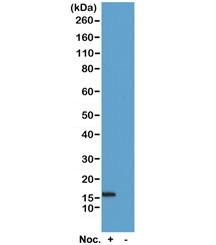
Phospho-Histone H2B Antibody Nocodazole Treated HeLa WB. Western blot analysis of acid extracts from untreated (-) and nocodazole-treated (+) human HeLa cells using Phospho-Histone H2B Antibody pSer14 clone RM238 detects a distinct band at the predicted molecular weight of Histone H2B. Signal is observed in nocodazole-treated cells, consistent with increased Histone H2B Ser14 phosphorylation, a chromatin-associated modification linked to apoptotic signaling, chromosome condensation, and cell cycle stress responses. This phospho-specific marker is widely used to investigate chromatin remodeling and nuclear events associated with cellular stress and programmed cell death.




 Powered by Bioz


 info@nsjbio.com