- Tel: 858.663.9055
 Email: info@nsjbio.com
- Tel: 858.663.9055
- Email: info@nsjbio.com
Email: info@nsjbio.com
IgE antibody detection is essential for studying allergic responses and hypersensitivity reactions. Immunoglobulin E (IgE) is a specialized antibody class involved in immune responses to allergens and parasitic infections. Accurate detection of IgE is critical for analyzing immune activation in allergy, inflammation, and immune regulation studies.
IgE Antibody for ELISA applications enables sensitive and reliable quantification of immunoglobulin E in serum, plasma, and other biological samples. These antibodies are widely used in immunology research, allergy studies, and immune response profiling where detection of IgE is required.
IgE is structurally distinct from other immunoglobulin classes and is present at relatively low concentrations in circulation. Despite its low abundance, IgE plays a potent role in immune responses by binding to high-affinity receptors on mast cells and basophils.
Upon antigen binding, IgE triggers activation of these cells, leading to release of histamine and other mediators involved in allergic inflammation. This mechanism underlies immediate hypersensitivity reactions and contributes to allergic disease pathology.
IgE Antibody for ELISA systems are optimized for sensitive and selective detection of immunoglobulin E in complex biological samples. These assays support:
Because IgE is typically present at low levels, high-sensitivity detection is essential for accurate measurement and interpretation of immune responses.
IgE antibodies are widely used in:
IgE detection provides valuable insight into allergic disease mechanisms, immune activation, and antigen-specific responses in both experimental and clinical research settings.
IgE antibodies provide essential tools for studying allergic responses and immune activation. Their ability to selectively detect immunoglobulin E enables precise analysis of hypersensitivity reactions, immune regulation, and antibody-mediated signaling.
Explore our immunoglobulin antibody collection to find IgG, IgA, IgM, and IgE antibodies optimized for ELISA-based detection and immunological analysis.
Researchers studying allergic immune responses, immunoglobulin mediated hypersensitivity pathways, and ELISA based antibody detection assays may also be interested in our Immunology Antibodies landing page featuring cytokines, immune markers, and host defense related proteins.
Browse the complete collection of research antibodies on our Antibodies landing page.
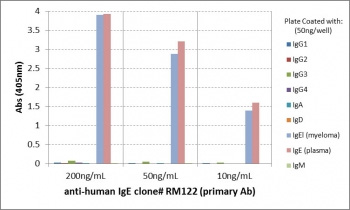
Human IgE Antibody for ELISA Subclass Specificity Analysis. ELISA analysis of human immunoglobulins demonstrates that clone RM122 selectively recognizes Human IgE / IGHE, with strong signal observed for IgE lambda from human myeloma and IgE derived from human plasma across tested concentrations. No cross-reactivity is detected with other immunoglobulin classes including IgG, IgM, IgD, or IgA.




 Powered by Bioz


 info@nsjbio.com