- Tel: 858.663.9055
 Email: info@nsjbio.com
- Tel: 858.663.9055
- Email: info@nsjbio.com
Email: info@nsjbio.com
Elastin (ELN) is a key extracellular matrix protein responsible for providing elasticity and resilience to tissues such as skin, lung, and blood vessels. It is a major component of elastic fibers, which allow tissues to stretch and recoil in response to mechanical forces. Elastin antibodies are widely used to detect ELN expression in connective tissues, where its distribution reflects the structural organization and functional properties of the extracellular matrix.
In normal tissues, Elastin is prominently localized within elastic fibers in the dermis, arterial walls, and pulmonary structures. Its highly organized deposition within the extracellular matrix makes it a valuable marker for studying tissue architecture, mechanical properties, and extracellular matrix remodeling.
Elastin antibodies are used across multiple research applications to evaluate extracellular matrix composition and tissue structure. In immunohistochemistry, Elastin antibodies enable visualization of elastic fibers in formalin-fixed, paraffin-embedded tissues, where staining highlights fiber networks within connective tissue and vascular structures.
In addition to tissue-based analysis, Elastin antibodies are used in immunodetection assays such as western blot and ELISA to assess protein expression and extracellular matrix composition in biological samples. These approaches support both qualitative and quantitative analysis of elastin in developmental, physiological, and disease contexts.
Elastin is highly expressed in tissues requiring elasticity, including large arteries, lung parenchyma, and skin. In these tissues, elastic fibers form organized networks that support structural integrity and mechanical function. In contrast, tissues with low elastic demand show minimal elastin expression.
Alterations in elastin expression and organization are associated with a variety of pathological conditions, including vascular disease, pulmonary disorders, and connective tissue abnormalities. Changes in elastic fiber structure and distribution can reflect tissue remodeling, degeneration, or altered mechanical properties, making elastin a useful marker for studying extracellular matrix dynamics.
Tissue microarray (TMA) analysis enables high-throughput evaluation of elastin distribution across diverse normal and disease tissues under standardized conditions. Elastin antibodies applied to TMA panels allow direct comparison of elastic fiber architecture across hundreds of tissue cores, providing a comprehensive view of extracellular matrix organization.
In TMA-based studies, strong staining is observed in elastic fiber-rich tissues such as arterial walls, lung parenchyma, and dermal connective tissue, while most cellular compartments remain negative. This distinct extracellular staining pattern highlights elastic fiber networks and supports detailed analysis of tissue structure, remodeling, and disease-associated changes.
A range of Elastin antibody reagents are available to support different research applications, including immunohistochemistry and other immunodetection assays. These antibodies enable reliable detection of ELN expression across a variety of sample types and experimental formats.
Researchers studying vascular elasticity, extracellular matrix organization, and arterial wall remodeling pathways may also be interested in our Cardiovascular Antibodies landing page featuring endothelial markers, structural proteins, and cardiovascular disease related targets.
Browse the complete collection of research antibodies on our Antibodies landing page.
A selection of Elastin antibody products is shown below to support a range of research applications.
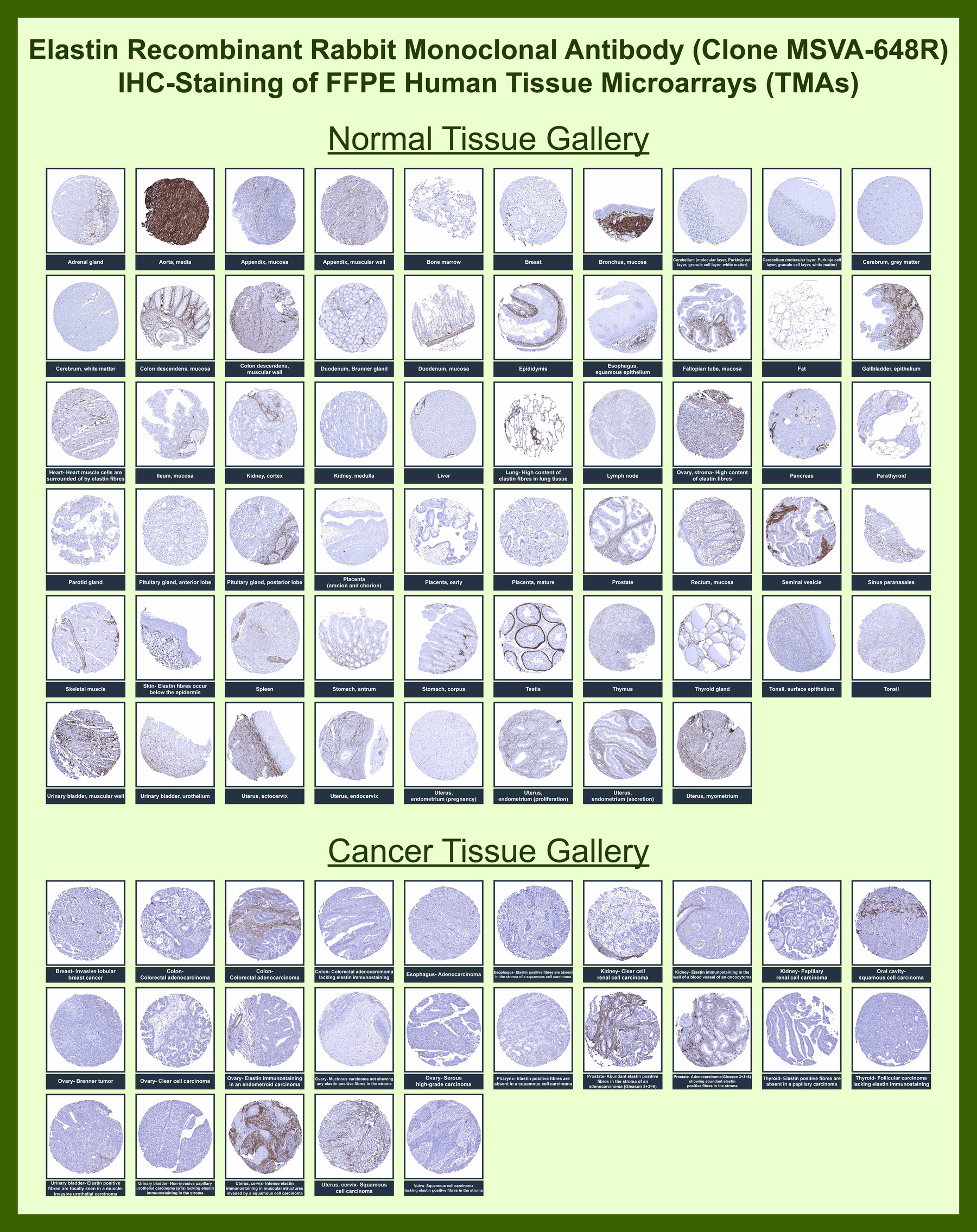
Elastin Antibody Tissue Microarray (TMA) Multi-Tissue Expression. Analysis of Elastin (ELN) distribution in FFPE human tissue microarray (TMA) sections using Elastin Antibody clone MSVA-648R demonstrates extracellular localization of elastic fiber networks in vascular, pulmonary, and connective tissue compartments, while epithelial and most cellular regions remain largely negative. In cancer tissue arrays, elastin highlights stromal and vascular-associated extracellular matrix structures with variable organization depending on tumor type. The distinct extracellular staining pattern outlines tissue architecture and elastic fiber organization across diverse tissue types, consistent with known elastin distribution and publicly available reference datasets.



 Powered by Bioz





 info@nsjbio.com