- Tel: 858.663.9055
 Email: info@nsjbio.com
- Tel: 858.663.9055
- Email: info@nsjbio.com
Email: info@nsjbio.com
Smooth Muscle Antibodies are valuable tools for investigating vascular biology, contractile function, tissue remodeling, and cellular differentiation. Smooth muscle cells are specialized contractile cells found throughout blood vessels, the gastrointestinal tract, respiratory tissues, urinary structures, and numerous other organ systems. These cells regulate vessel tone, organ motility, and tissue homeostasis while responding dynamically to physiologic and pathologic stimuli.
Antibodies directed against smooth muscle markers enable researchers to identify smooth muscle populations, evaluate contractile protein expression, and investigate the molecular pathways that regulate smooth muscle development, function, and disease-associated remodeling.
Smooth muscle cells differ from skeletal and cardiac muscle because they lack organized sarcomeres and instead utilize a contractile apparatus adapted for sustained contraction and tissue regulation. Their function depends on coordinated interactions among actin filaments, myosin proteins, cytoskeletal elements, and signaling pathways that regulate contraction and relaxation.
These cells play central roles in controlling vascular resistance, blood pressure, airway tone, gastrointestinal motility, and urinary tract function. Antibodies directed against smooth muscle-associated proteins help researchers investigate the mechanisms that regulate smooth muscle contractility, cellular plasticity, and tissue organization.
Frequently studied smooth muscle-associated proteins include:
These markers support investigations into smooth muscle differentiation, contractile activity, vascular remodeling, and tissue-specific cellular organization.
Smooth muscle cells are essential components of blood vessel walls and play major roles in vascular development, arterial remodeling, angiogenesis-associated processes, and cardiovascular disease. Alterations in smooth muscle cell phenotype contribute to atherosclerosis, hypertension, vascular injury responses, and other cardiovascular disorders.
Researchers frequently use smooth muscle antibodies to investigate vessel structure, cellular differentiation, and signaling pathways involved in vascular biology. These studies improve understanding of how smooth muscle cells contribute to normal vascular function and disease progression.
Unlike many terminally differentiated cell types, smooth muscle cells can transition between contractile and synthetic phenotypes in response to injury, inflammation, and environmental stimuli. This cellular plasticity contributes to tissue repair, remodeling, and disease-associated changes within blood vessels and other organs.
Smooth muscle antibodies support investigations into differentiation pathways, cytoskeletal organization, contractile protein expression, and cellular responses to physiologic stress. These studies are important for understanding tissue remodeling and regenerative processes across multiple organ systems.
Smooth Muscle Antibodies are commonly used for:
These antibodies support investigations into both normal smooth muscle physiology and disease-associated biological processes.
The Smooth Muscle Antibody collection includes antibodies directed against proteins involved in contractility, cytoskeletal organization, cellular differentiation, tissue remodeling, and vascular function. These reagents support investigations into smooth muscle development, vascular biology, contractile regulation, and disease-associated molecular mechanisms.
Researchers studying vascular remodeling, contractile signaling pathways, and blood vessel biology may also be interested in our Cardiovascular Antibodies landing page featuring endothelial markers, signaling mediators, and cardiovascular disease related targets.
Browse the complete collection of research antibodies on our Antibodies landing page.
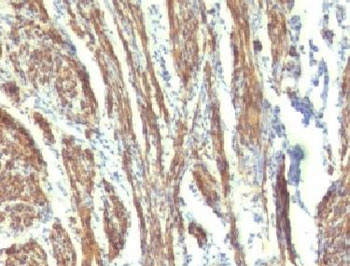
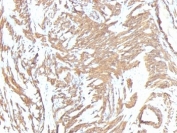
Caldesmon Antibody Human Uterus Smooth Muscle IHC. Immunohistochemistry analysis of FFPE human uterus tissue using Caldesmon Antibody clone CDSM-3 demonstrates strong HRP-DAB brown cytoplasmic staining throughout smooth muscle cells of the myometrium. The staining pattern highlights elongated smooth muscle fibers arranged in characteristic interlacing bundles and is consistent with the established expression of Caldesmon (CALD1), an actin- and myosin-associated regulatory protein involved in cytoskeletal organization, contractile function, and smooth muscle differentiation. This image illustrates the prominent smooth muscle localization of CALD1 and supports studies of smooth muscle biology, contractile regulation, and vascular-associated cytoskeletal signaling pathways.


 Powered by Bioz




 Citations (9)


 info@nsjbio.com