- Tel: 858.663.9055
 Email: info@nsjbio.com
- Tel: 858.663.9055
- Email: info@nsjbio.com
Email: info@nsjbio.com
Keratin proteins, encoded by KRT genes, are a diverse family of intermediate filament proteins that regulate epithelial cell structure, differentiation, and tissue-specific identity. KRT antibody reagents are used to study how individual keratin proteins define epithelial subtypes and contribute to tissue organization.
Unlike broad cytokeratin antibody detection approaches, KRT antibody tools enable analysis of specific keratin proteins associated with defined epithelial states. Different KRT proteins are expressed in basal, differentiated, glandular, or specialized epithelial cells, allowing precise characterization of epithelial phenotype.
The keratin family consists of type I (acidic) and type II (basic to neutral) proteins that form obligate heterodimers and assemble into intermediate filaments. These filaments provide mechanical support while also contributing to intracellular signaling and structural organization.
KRT gene expression is tightly coordinated, with specific keratin pairs associated with distinct epithelial cell types. Basal epithelial cells, simple epithelia, and stratified tissues each express characteristic keratin combinations that reflect functional specialization.
Because of this structured organization, KRT antibodies are valuable tools for studying epithelial lineage relationships and tissue-specific differentiation programs.
Keratin expression patterns change dynamically as epithelial cells differentiate. Basal epithelial cells typically express keratins such as KRT5 and KRT14, which are associated with proliferative capacity and structural support.
As cells differentiate, expression shifts toward keratins such as KRT1 and KRT10 in stratified epithelia or KRT8 and KRT18 in simple epithelial tissues. Specialized epithelial structures, including glandular and mucosal tissues, exhibit additional keratin profiles that reflect their functional roles.
These differentiation-dependent expression patterns make KRT antibody tools particularly useful for studying epithelial development, tissue remodeling, and cellular specialization.
Key keratin proteins commonly studied include:
Selection of a KRT antibody depends on the epithelial subtype and differentiation state being studied. Individual keratin proteins provide insight into specific biological contexts rather than general epithelial identification.
For example, basal keratins are associated with proliferative epithelial compartments, while differentiation-associated keratins indicate more mature epithelial states. Glandular keratins are often used to characterize secretory epithelia and tissue-specific function.
Because keratin expression is highly context-dependent, selecting the appropriate KRT target is essential for accurate interpretation of epithelial biology. Antibodies such as KRT19 antibody are widely used when evaluating broadly expressed epithelial keratin profiles across multiple tissue types.
KRT antibodies are used across multiple experimental approaches to study epithelial differentiation and tissue organization.
KRT antibodies are used to evaluate epithelial differentiation patterns and tissue architecture, particularly when distinguishing epithelial subtypes.
Detection of individual keratin proteins allows comparison of expression profiles across different epithelial cell types.
KRT antibodies reveal filament organization and intracellular distribution of keratin networks.
KRT antibodies can be used to identify epithelial populations based on intracellular keratin expression.
While KRT antibodies focus on individual keratin proteins, cytokeratin antibody approaches are often used for broader epithelial detection across multiple keratin types.
The KRT Antibody Panel provides a focused approach to studying keratin protein diversity, supporting detailed analysis of epithelial differentiation, tissue identity, and cellular specialization.
For access to a full range of epithelial detection reagents, including broadly reactive cytokeratin antibodies, visit the Cytokeratin antibody page.
This Cytokeratin antibody page is part of a broader antibody panel offered by NSJ Bioreagents.
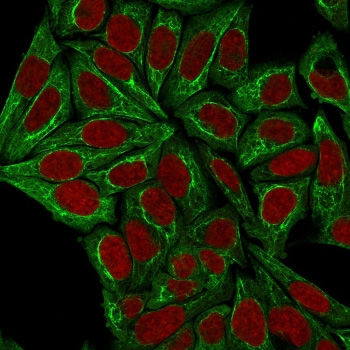
Pan Cytokeratin Antibody IF. Immunofluorescent staining of permeabilized human HeLa cells with Pan Cytokeratin antibody (clone PCK/3150, green) and Reddot nuclear stain (red).


 info@nsjbio.com