- Tel: 858.663.9055
 Email: info@nsjbio.com
- Tel: 858.663.9055
- Email: info@nsjbio.com
Email: info@nsjbio.com
Cystatin A (CSTA), also known as Stefin A, is a cysteine protease inhibitor that plays a key role in epithelial cell differentiation and barrier function. It is predominantly expressed in stratified squamous epithelia, where it contributes to regulation of intracellular protease activity and maintenance of epithelial integrity. Cystatin A antibodies are widely used to detect CSTA expression in epithelial tissues and tumors, where expression patterns provide insight into cellular differentiation and lineage identity.
In normal tissues, Cystatin A is primarily localized to squamous epithelial cells, while most glandular, stromal, and non-epithelial tissues show minimal expression. In cancer, expression is frequently retained or increased in squamous cell carcinomas, making CSTA a useful marker for identifying squamous differentiation and epithelial lineage.
Cystatin A antibodies are used across multiple research applications to evaluate epithelial differentiation and protein expression. In immunohistochemistry, these antibodies enable visualization of cytoplasmic staining patterns in stratified squamous epithelia within formalin-fixed, paraffin-embedded tissues, supporting identification of squamous cell populations and tumor cell differentiation states.
In addition to tissue-based analysis, Cystatin A antibodies are used in immunodetection assays such as western blot and ELISA to assess protein expression in cell lysates and biological samples. These approaches support both qualitative and quantitative evaluation of CSTA expression across different experimental systems.
Cystatin A expression is strongly associated with squamous epithelial tissues, including skin, esophagus, and tonsil, where it shows characteristic cytoplasmic localization. In contrast, most non-squamous tissues exhibit little to no detectable expression.
In cancer, Cystatin A is commonly expressed in squamous cell carcinomas, where staining patterns reflect squamous differentiation and tumor cell identity. This makes it a valuable marker for distinguishing squamous tumors from adenocarcinomas and other non-squamous malignancies. Differences in expression patterns between normal and tumor tissues support its use in studies of epithelial differentiation and tumor classification.
Tissue microarray (TMA) analysis enables large-scale evaluation of Cystatin A expression across diverse normal and cancer tissues under standardized conditions. Cystatin A antibodies applied to TMA panels allow direct comparison of staining patterns across hundreds of tissue cores, providing a comprehensive overview of expression distribution.
In TMA-based studies, strong staining is consistently observed in squamous epithelial tissues and squamous cell carcinomas, while non-epithelial tissues remain largely negative. This contrast supports the specificity of Cystatin A as a squamous epithelial marker and highlights its value in large-scale tissue profiling and biomarker research.
A range of Cystatin A antibody reagents are available to support different research applications, including immunohistochemistry and other immunodetection assays. These antibodies enable reliable detection of CSTA expression across a variety of sample types and experimental formats.
Researchers studying epithelial barrier defense, cysteine protease inhibition, and inflammatory signaling pathways may also be interested in our Immunology Antibodies landing page featuring cytokines, immune regulators, and host defense related proteins.
Browse the complete collection of research antibodies on our Antibodies landing page.
A selection of Cystatin A antibody products is shown below to support a range of research applications.
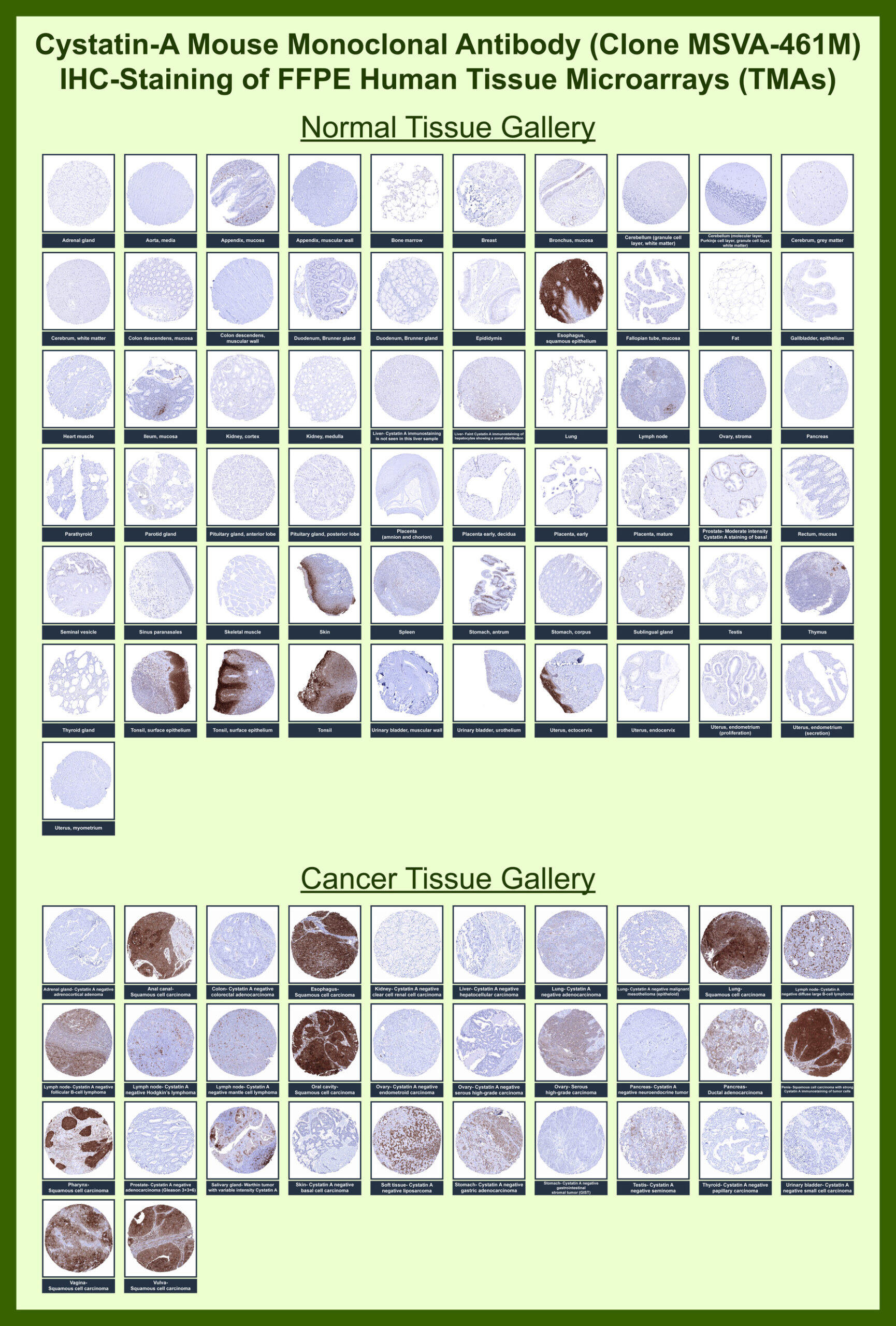
Cystatin A Antibody Tissue Microarray (TMA) Multi-Tissue Expression Analysis. Immunohistochemistry analysis of Cystatin A (CSTA) expression in FFPE human tissue microarray (TMA) sections demonstrates strong cytoplasmic HRP-DAB brown staining in stratified squamous epithelia in normal tissues, while cancer tissue microarrays show diffuse cytoplasmic staining in squamous cell carcinoma tumor cells with minimal background in non-epithelial tissues, supporting its role as a squamous epithelial marker.


 Powered by Bioz






 info@nsjbio.com