- Tel: 858.663.9055
 Email: info@nsjbio.com
- Tel: 858.663.9055
- Email: info@nsjbio.com
Email: info@nsjbio.com
Stem Cell Antibodies are essential tools for investigating cellular differentiation, tissue development, regenerative biology, and progenitor cell function. Stem cells possess the unique ability to self-renew while also generating specialized cell types that contribute to tissue growth, maintenance, and repair. Antibodies directed against stem cell markers enable researchers to identify stem and progenitor cell populations and investigate the molecular mechanisms that regulate cell fate decisions.
Stem cell biology remains one of the most active areas of biomedical research due to its importance in development, tissue homeostasis, disease progression, and regenerative medicine. Stem cell antibodies support studies aimed at understanding how cellular identity is established, maintained, and modified throughout life.
Stem cells exist in many tissues and organ systems, where they contribute to growth, maintenance, and repair. These cells are regulated by complex networks of transcription factors, signaling molecules, cell surface receptors, and intracellular regulatory proteins that coordinate self-renewal and differentiation.
The ability of stem cells to transition into specialized cell types depends upon tightly regulated developmental programs. Antibodies directed against stem cell-associated proteins allow researchers to investigate lineage commitment, progenitor cell behavior, and the molecular pathways that influence cellular plasticity.
Understanding these processes is important for developmental biology, tissue regeneration, and disease-associated cellular remodeling.
Frequently studied stem cell-associated proteins include:
These markers support investigations into stem cell maintenance, progenitor cell populations, differentiation pathways, and tissue-specific developmental programs.
During embryonic and postnatal development, stem and progenitor cells generate the diverse cell populations that form tissues and organ systems. Developmental transcription factors, signaling pathways, and epigenetic regulators coordinate these processes to ensure proper tissue formation and maturation.
Stem Cell Antibodies are frequently used to study developmental regulators that control lineage specification, organogenesis, and cellular differentiation. These investigations continue to improve understanding of normal development and disease-associated alterations in developmental pathways.
Stem cell-associated pathways are increasingly studied in cancer biology, fibrosis, tissue remodeling, and degenerative disease research. Alterations in differentiation programs and progenitor cell regulation can contribute to abnormal tissue growth, impaired regeneration, and disease progression.
Researchers frequently utilize stem cell antibodies to investigate cellular plasticity, tissue regeneration, cancer stem cell biology, and molecular mechanisms that regulate long-term tissue maintenance. These studies provide important insights into both normal physiology and disease-associated biological processes.
Stem Cell Antibodies are commonly used for:
These antibodies support investigations into stem cell populations across numerous tissues and organ systems.
The Stem Cell Antibody collection includes antibodies directed against proteins involved in self-renewal, lineage specification, developmental regulation, cellular plasticity, and tissue regeneration. These reagents support investigations into stem cell maintenance, differentiation pathways, developmental biology, and disease-associated cellular remodeling.
Researchers studying developmental transcriptional regulation, cellular differentiation pathways, and lineage specification mechanisms may also be interested in our Cell Biology Antibodies landing page featuring nuclear markers, intracellular regulators, and signaling related targets.
Browse the complete collection of research antibodies on our Antibodies landing page.
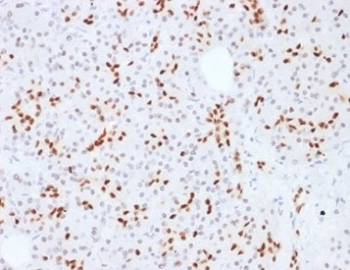
SOX9 Antibody Human Pancreas IHC. Immunohistochemistry analysis of FFPE human pancreas tissue using SOX9 Antibody clone SOX9/2387 demonstrates strong HRP-DAB brown nuclear staining within pancreatic ductal epithelial cells and scattered SOX9-positive progenitor-associated cell populations. The staining pattern is consistent with the established role of SRY-box transcription factor 9 (SOX9) as a key regulator of cellular differentiation, developmental lineage specification, and stem cell maintenance. This image highlights nuclear SOX9 expression in pancreatic epithelial compartments and supports studies of stem cell biology, developmental regulation, tissue regeneration, and progenitor cell function. HIER: heat-induced epitope retrieval performed using pH 9 Tris-EDTA buffer.
| ||

|
| ||
|
|
| ||
|
|


 Powered by Bioz


 info@nsjbio.com